





What Is a Trading Strategy?
A structured plan that guides every trading decision before the market opens.
Authorship
Written by

Forex Market Analyst , an ICT Chartered Graduate with 18 years of live trading experience in forex, gold, and crypto.
Reviewed by

Forex market analyst and educator with a strong focus on technical analysis and trader psychology.
Key Takeaways
-
A trading strategy is a complete, written set of rules that defines when to enter a trade, where to place the stop, where to take profit, how much to risk, and what to do once the trade is open. Without all components in place before the trade is opened, the plan is incomplete.
-
The entry rule is the most discussed part of any strategy. It is also the least sufficient in isolation. A good entry with a poor exit or incorrect position size produces a losing system. All components work together and none can be ignored.
-
A strategy is only proven over a meaningful sample of trades, typically 50 to 100, not over one or two results. Consistency of execution is what allows the edge to express itself over time.
What Is a Trading Strategy?
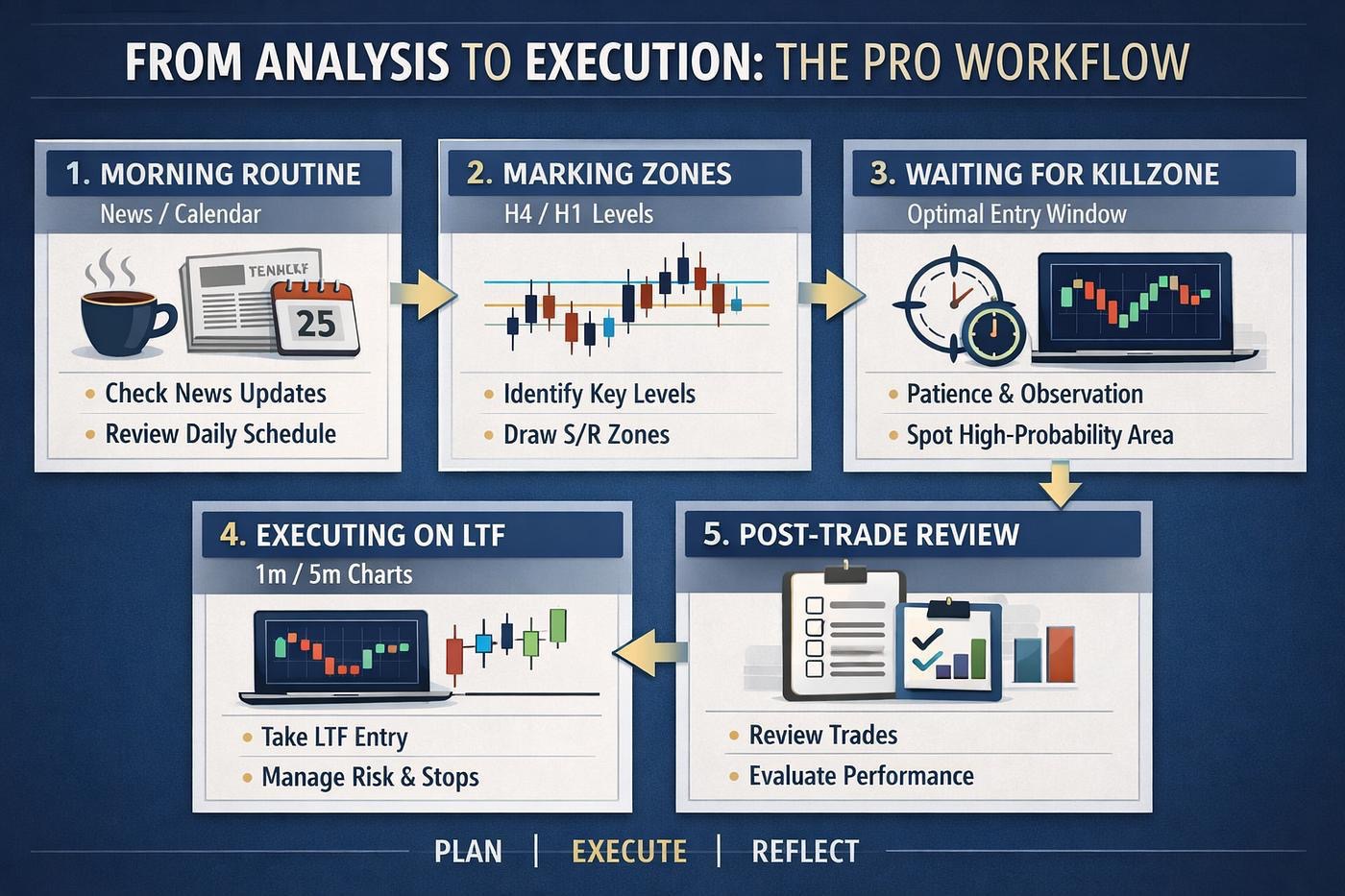
Many traders enter the forex market believing that success comes from finding the right indicator or copying someone else's trades. After a few losing trades, they switch to a different indicator. Then another strategy. Then a different trading style entirely. Months pass and little progress is made. The problem is rarely the market. It is the absence of a strategy. A strategy does not eliminate losing trades. It creates a consistent process for managing them.
If you have not yet read Risk Management, start there before continuing.
A trading strategy is a structured set of rules that defines how you analyse the market and execute trades. It answers the questions that must not be left open once a position is live: what will I trade, on which timeframe, when will I enter, where does the stop go, where do I take profit, how much goes in, and what do I do between entry and exit. Those decisions made in real time, under market pressure, without pre-defined rules, produce inconsistent results. Not because the trader lacks knowledge but because the rules are being invented at the worst possible moment.
Why every trader needs a strategy
Without a strategy, the same patterns appear repeatedly. Traders chase price after missing an entry. They enter impulsively on signals that do not meet any defined criteria. They exit winning trades too early because profit feels better than holding. They hold losing trades too long because closing at a loss feels like admitting a mistake. They change methods after every loss before giving any approach enough trades to be evaluated. A strategy removes all five of these failure modes by replacing emotional decision-making with a repeatable process. It also provides the only honest basis for improvement: written rules that can be tested, measured, and refined based on data rather than on how last week felt.
How Does It Work?
Market and timeframe
The first decision is what to trade and on which chart. A strategy that works on EUR/USD at the daily level does not automatically transfer to GBP/JPY at the 5-minute level. The market and timeframe shape everything else: how long positions are held, how much room the stop needs, how often setups appear, and how much time the trader must spend at the screen. This decision should be made based on schedule and temperament, not on which chart looked most active on any particular day. Most experienced traders work with a small number of pairs they understand well rather than scanning everything.
Entry rule
The entry rule defines the specific conditions that must all be met before a trade can be opened. It must be objective enough to apply consistently: not when momentum looks strong but when price closes above the 50-period EMA on the 4H chart and RSI is recovering from below 45. That specificity is not bureaucratic precision for its own sake. It is what allows back-testing, allows comparison across changing conditions, and allows the trader to apply the rule consistently under the pressure of a live market.
Stop loss
The stop loss defines where the trade is wrong. It is placed before the position is opened and does not move in the losing direction once it is live. Placement should come from market structure: below a recent swing low for a long trade, above a recent swing high for a short. A stop placed at an arbitrary pip distance rather than at a structural level produces stops that are too tight in volatile markets and too wide in quiet ones. The stop distance also determines position size, which is why the two are calculated together.
Take profit
The take profit defines where the trade is closed when it moves in the intended direction. Most strategies use either a fixed reward to risk target, take profit at two times the stop distance for a 2:1 ratio, or a structural target at the next significant resistance level on a higher timeframe. Both are valid. What is not valid is leaving the take profit undefined and deciding when to close based on how the position feels in the moment. That produces an exit driven by emotion rather than by the strategy.
Position size
Position size determines how much capital is at risk on any single trade. The standard professional guideline for retail traders is 1 to 2% of account equity per trade. At 1%, a losing streak of ten consecutive trades reduces the account by approximately 10%, which is survivable and recoverable. At 5%, the same streak removes nearly half the capital. Position size is calculated from the stop loss distance and the maximum account risk percentage, not from confidence in the setup. The formula: divide the maximum risk amount by the stop loss distance in pips multiplied by the pip value.
Trade management
A strategy must also define what happens between entry and exit. Will the stop loss be moved to breakeven once the trade reaches a certain profit? Will partial profits be taken at an intermediate level? Will the trade be held to the full target without adjustment? Having clear answers to these questions before the trade is opened prevents the most common form of emotional interference: changing the plan mid-trade because the position is moving or not moving as expected. The rules for trade management are part of the strategy, not afterthoughts.
Types of strategy
Strategies are generally categorised by the market condition they exploit. Trend following strategies enter in the direction of an established trend, typically on pullbacks, and perform best in directional markets. Support and resistance strategies trade bounces from identified price levels and work across all timeframes. Breakout strategies enter when price moves through a defined level with momentum. Reversal strategies attempt to identify turning points when trends are losing energy. There is no single best approach. The right strategy is the one that suits the trader's schedule, temperament, and the market conditions in which they perform best.
Systematic versus discretionary
A systematic strategy applies rules mechanically: if conditions are met, the trade is taken. No additional judgement is required. A discretionary strategy uses defined criteria as a framework but allows the trader to apply judgement about whether conditions are genuinely met given the broader context. Both approaches work. Systematic strategies are easier to test and to execute consistently. Discretionary strategies can adapt but introduce the trader's psychology as a variable in every decision. Most traders begin systematic and introduce discretion gradually as experience accumulates.
Expectancy
A strategy has a positive edge when it produces profit over a large enough sample. The measure of that edge is expectancy: win rate multiplied by average win size, minus loss rate multiplied by average loss size. A strategy with a 40% win rate, an average win of 2R, and an average loss of 1R produces a positive expectancy of 0.2R per trade. That strategy is profitable over time even though it loses more trades than it wins. Expectancy removes the pressure to win every trade and replaces it with the correct objective: follow the rules consistently across enough trades for the edge to compound.
A good strategy evolves
Markets change. A strategy that worked in 2022 trending markets may underperform in the ranging conditions that followed. Regular review is part of the process. The review should be based on evidence from a trading journal, not on the emotional response to a recent losing streak. Record every trade: the setup conditions, entry, stop, target, outcome, and whether the rules were followed exactly. That record is the only honest basis for identifying what is working, what is not, and where the rules need refinement. Changes made from frustration produce a new strategy with no track record. Changes made from journal data improve a strategy with a known history.
Example
The following shows what a complete, written strategy framework looks like when all components are populated. This is a trend pullback strategy using tools covered in the technical and fundamental analysis series.
|
Strategy Component |
Trend Pullback Strategy: EUR/USD |
|
Market and timeframe |
EUR/USD. Daily chart for trend direction. 4H chart for entry timing. |
|
Trend filter |
Price is above the 200-period SMA on the daily chart. Only long trades taken. |
|
Entry rule |
Price pulls back to the rising 50-period EMA on the 4H chart. RSI recovers from below 45 back above 50. A bullish candlestick pattern confirms rejection at the EMA. |
|
Stop loss |
Placed below the nearest 4H swing low, below the pullback low. |
|
Take profit |
At the next significant resistance level on the daily chart. Minimum 2:1 reward to risk required. If no level exists at 2:1 or better, the trade is not taken. |
|
Position size |
1% of account equity per trade. Calculated from stop distance and account balance before the trade is opened. |
|
Trade management |
Stop moved to breakeven once price reaches 1:1. No early exits unless the daily chart trend filter is broken. |
|
What invalidates the setup |
Price closes below the 200-period SMA on the daily chart. No long trades taken until the filter is reassessed. |
This strategy uses one trend filter, one entry condition, one confirmation signal, and one structural stop. It is specific enough to be applied consistently and tested across a meaningful sample. A trader running it across 50 trades, tracking win rate, average win, average loss, and expectancy, would have the data needed to know whether the rules produce a positive edge or require adjustment.
The strategy does not predict what the market will do. It defines a repeatable process for identifying setups where the conditions, based on what has historically preceded favourable moves in this pair and timeframe, are skewed in the trader's favour. The edge comes from consistency across many trades, not from any individual result.
Why It Matters
A strategy matters because it is the only thing that separates trading from guessing. Markets do not reward knowledge, intelligence, or effort in isolation. They reward consistent application of a process that has a positive expected value over time. That process is a strategy.
Written rules also change how a trader relates to losses. Without a strategy, a losing trade is evidence that something went wrong. With a strategy, a losing trade that followed the rules is the cost of doing business, already accounted for in the expectancy calculation. The question after a loss is not where did I go wrong but did I follow the rules. If yes, nothing changes. If no, the discipline needs attention, not the rules.
The strategy framework covered in this article connects to Risk Management at every decision point. The stop loss placement, the position size calculation, and the minimum reward to risk requirement are all risk management applications built into the strategy's rules. For the complete framework for protecting capital and sizing positions across different market conditions, read Risk Management alongside this topic.
Common Mistakes
|
Mistake |
Why It Matters |
|
|
Mistake 1 |
Changing the strategy after a losing streak |
Three to five losing trades in sequence is normal for any strategy with a 40 to 60% win rate. Changing the rules after a small losing streak produces a strategy whose edge is unknown. Changes to strategy rules should be made based on large sample data, not on the emotional response to recent losses. |
|
Mistake 2 |
Defining only the entry and ignoring the exit |
An entry rule tells you when to open a trade. Without equally specific exit rules, every closing decision is made in real time under pressure, which is exactly the condition that produces inconsistent results. Stop loss, take profit, and trade management rules are at least as important as the entry and must be defined with equal precision. |
|
Mistake 3 |
Treating a small sample as proof of an edge |
A strategy that produces ten winning trades in a row on a demo account has not proven it has an edge. A meaningful sample requires 50 to 100 trades across varying market conditions to produce a win rate and expectancy figure worth trusting. Small samples lead to going live with a strategy that has not yet been properly tested. |
Quick Summary
- A trading strategy is a complete, written set of rules covering market and timeframe selection, entry conditions, stop loss placement, take profit target, position sizing, and trade management. All components must be defined before any trade is opened.
- A strategy's edge is measured by expectancy: win rate multiplied by average win size, minus loss rate multiplied by average loss size. A strategy with positive expectancy is profitable over time even with a win rate below 50%. Consistency of execution is what allows the edge to express itself.
- Strategy changes should be based on large sample data tracked in a trading journal, not on short-term results. A simple strategy followed consistently is more effective than a complex one that is modified after every loss.
Next Steps
You now understand what a complete trading strategy looks like and why each component is necessary. The next step is building the first and most detailed component with precision.
Entry Rules - Learn how to define precise entry conditions that are specific enough to apply consistently, how to use market structure and indicator confirmation to improve entry timing, and how to avoid the most common entry errors.
Risk Management - Revisit the full framework for protecting capital, sizing positions, and managing trades from entry to exit.
Take Action
Write down your current approach to trading using the six-component template: market and timeframe, entry rule, stop loss, take profit, position size, and trade management. Be specific enough that someone else could read the rules and trade them exactly as intended. If any component cannot be written down with that precision, that is the gap to address first. Once all six components are written, take the strategy to a demo account and run it across at least 30 trades before drawing any conclusions. Record every trade: the setup conditions, entry price, stop, target, outcome, and whether you followed the rules. A simple strategy followed consistently is more effective than a complex one that is ignored. Test your strategy on a demo account across at least 50 trades before applying it in live trading.


