





Exit Rules
Learn the three exit scenarios every trade needs, how to place stops and take profits correctly, and why written exit rules beat real-time decisions.
Authorship
Written by

Forex Market Analyst , an ICT Chartered Graduate with 18 years of live trading experience in forex, gold, and crypto.
Reviewed by

Forex market analyst and educator with a strong focus on technical analysis and trader psychology.
Key Takeaways
- Exit rules cover three distinct scenarios: where the trade is wrong and must be closed at a loss (the stop loss), where the trade has reached its intended target and is closed in profit (the take profit), and what happens between entry and exit while the trade is live (trade management).
- The stop loss is placed before the trade is opened and does not move in the losing direction once the position is live. It is placed at a structural level that invalidates the trade's logic, not at an arbitrary pip distance from entry.
- Exits are harder than entries because entries involve one decision made in advance. Exits involve continuous pressure from the open position. Written exit rules remove both the greed that prevents profit-taking and the hope that prevents loss-cutting from the moments they cause the most damage.
What Are Exit Rules?
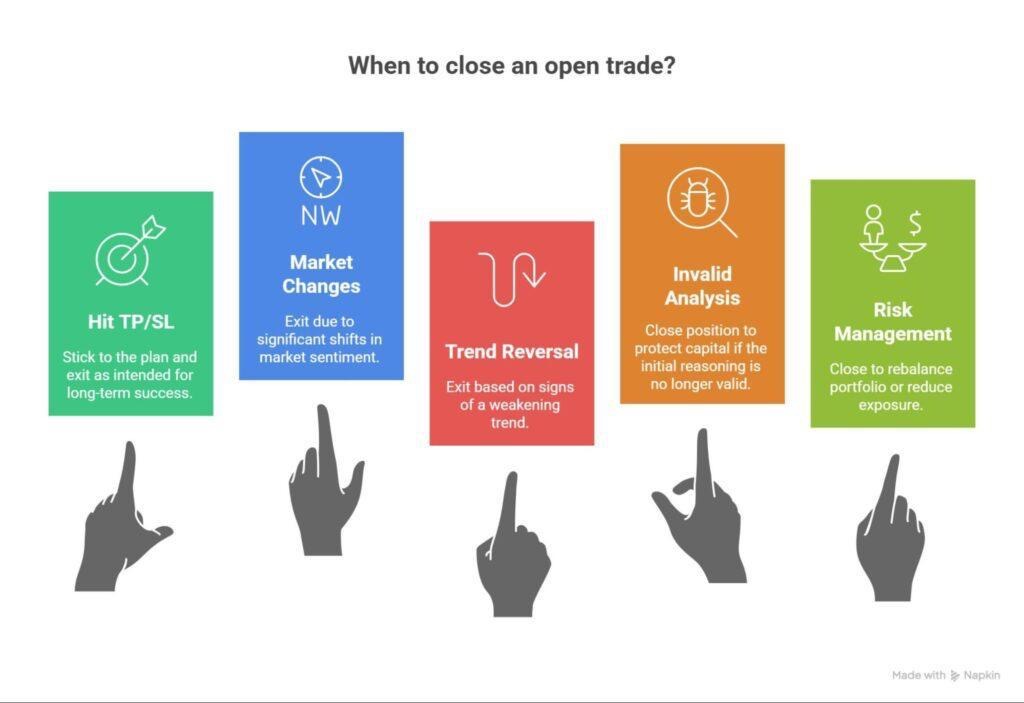
Many traders spend hours searching for the right entry. They analyse charts, indicators, and candlestick patterns until they find what looks like the ideal setup. Then the trade opens. Suddenly, uncertainty takes over. Should they take profit now? Should they hold for a bigger move? Should they move the stop loss? Should they close before the market reverses? Without written exit rules, those questions are answered by emotion in the worst possible moment. A profitable trade turns into a loss. A small loss becomes a large one.
If you have not yet read Risk Management, start there before continuing.
Exit rules are the predefined conditions that determine when a trade is closed under all three scenarios it can produce. The stop loss handles the losing scenario. The take profit handles the winning scenario. Trade management handles everything between those two points. A complete trading strategy must answer all three before any position is opened. Good exit rules do not eliminate losing trades. They ensure that losing trades stay within their defined limits and that winning trades reach their intended targets without being cut short by impatience or extended by greed.
Why exit rules matter
Many beginners focus almost exclusively on entry signals. Professional traders understand that profits are determined just as much by the exit as the entry. Without exit rules, traders hold losing trades hoping for recovery, close winning trades too early because the profit feels real and the risk of losing it does not, allow fear to override the original plan, and ignore the changing conditions that signal a trade has stopped working. Exit rules provide the consistency that transforms a set of entry signals into a strategy that can be evaluated and improved over time.
How Does It Work?
The stop loss
A stop loss is an order placed with the broker that automatically closes the trade if price reaches a specified level in the losing direction. It limits the maximum loss before any decision is required. Without it, the maximum loss is unlimited.
Stop loss placement must come from market structure. For a long trade, the stop goes below the most recent swing low that the trade's logic depends on. If the trade is a pullback to a support level, the stop goes below that support at a distance that accounts for normal intraday volatility. If price closes below that level, the structure that justified the trade no longer exists. Placing the stop there means the trade is closed precisely when it is wrong. A stop placed at an arbitrary pip distance gets triggered by normal market noise rather than by a genuine failure of the trade's logic.
The take profit
The take profit is the price level where the trade is closed when it moves in the intended direction, defined before the trade opens. Structural targets place the take profit at the next significant resistance level above the entry for a long trade. These are the price levels where the market has previously shown a reaction and where sellers are likely to appear again. Ratio-based targets set the take profit at a fixed multiple of the stop loss distance: a 2:1 ratio means the take profit is twice as far from the entry as the stop. When structural and ratio-based targets align, the setup is at its strongest.
Trailing stops
A trailing stop is a dynamic stop that moves in the profitable direction as price advances but remains fixed if price reverses. Rather than locking in a specific target, it lets the trade run in a trend while protecting a portion of the accumulated gain. In a strong trend, a trailing stop allows the trade to capture far more than a fixed take profit would have produced. In a trend that stalls and reverses, it closes the trade automatically once price pulls back to the threshold. Trailing stops work best in trending markets. In ranging conditions, normal pullbacks trigger the stop before the trend resumes.
Breakeven stops and trade management
Once a trade has moved a meaningful distance in the intended direction, moving the stop loss to the entry price removes the risk of a losing outcome on a trade that was profitable. The specific level at which to move to breakeven should be defined in the strategy before the trade opens: typically once price has moved at least 1:1 in the profitable direction. Beyond breakeven, the stop can be trailed to each new structural level the trade passes through, locking in progressively more profit as the trade develops without requiring a real-time decision.
Scale-out exits
Taking profit in stages addresses the tension between securing available profit and letting winners run. A scale-out plan closes a defined portion of the position at the first target, moves the stop to breakeven on the remainder, and runs the rest of the position toward a more ambitious level. Closing 50% at a 2:1 target removes the risk from the remaining position because the profit from the first half offsets the maximum loss on the second half. The remaining position can then chase a larger target without the pressure of watching unrealised profit disappear if price pulls back.
Exiting on market structure
Not every exit depends on a fixed price target. Some exits are triggered by a structural change that signals the trade's original thesis has broken down, regardless of whether the stop or target has been reached. A break of a key support level, the appearance of lower highs replacing the higher highs that defined an uptrend, or a reversal pattern completing at resistance are all conditions that can trigger a managed exit before the original stop is hit. Exiting on structure changes allows traders to close while the loss is smaller than the full stop distance, and to redeploy capital into a new setup rather than waiting for the stop to print.
Early exits on fundamental change
When an unscheduled fundamental event changes the basis on which the trade was placed, such as an unexpected central bank intervention, a geopolitical shock, or a data release that directly contradicts the trade's directional assumption, the logic of the trade has changed. The rules no longer apply to the new environment. Exiting early in this situation is not breaking the rules. The trade was right for specific reasons. Those reasons no longer exist.
Time-based exits
For traders who do not hold positions overnight or who prefer not to hold through high-impact events, a time-based rule closes the trade at a defined time regardless of where price is. If the trade has not reached its target by the end of the session, it is closed. This eliminates overnight gap risk and ensures no exposure to events outside the trader's control while the position is live.
Good exit rules require discipline
The best exit rules are simple enough to follow consistently under pressure. Changing targets after every candle or moving the stop out of fear produces inconsistent results that cannot be evaluated or improved. The plan for managing the trade is decided before the position is opened. Once live, the plan is followed unless market conditions change in a way that the strategy has already defined as an early exit signal. Discipline here is not about willpower in the moment. It is about having rules specific enough that the moment of doubt has a written answer.
Example
The GBP/USD ascending channel provides a complete exit planning framework. All structural data is confirmed: channel lower boundary second touch at 1.3320 on April 14, 2026, channel upper boundary second touch at 1.3605 on April 28, 2026, channel width approximately 270 pips.
| Exit Component | GBP/USD Channel Trade: April 2026 |
| Entry (from Channels article) | Long at 1.3320, channel lower boundary second touch (14 April 2026) |
| Stop loss | 1.3270, below the 14 April channel low (50 pips below entry) |
| Structural justification | Close below 1.3270 breaks the channel lower boundary and invalidates the channel structure |
| Take profit | 1.3595, just ahead of the channel upper boundary (275 pips above entry) |
| Risk to reward | Approximately 1:5.5 |
| Partial exit rule | Close 50% of position at 1.3450 (first channel high, 130 pips); move stop to breakeven |
| Breakeven stop | Moved to 1.3320 (entry) once price clears 1.3370 (1:1 in profit) |
| Remaining position | Run toward 1.3595 with stop trailing behind each new swing low |
| Actual outcome | GBP/USD channel high second touch reached 1.3605 on 28 April 2026 |
The exit plan existed before the trade was opened. The stop at 1.3270 defined the maximum risk. The partial exit at 1.3450 defined when to reduce exposure and lock in a portion of the move. The breakeven move removed the risk of a losing outcome once the first partial was taken. The trailing stop on the remaining half allowed the position to run toward the upper boundary without requiring a real-time decision about whether to hold or close.
A trader running this plan did not need to make a single exit decision while the trade was live. Every scenario had a pre-defined response. That is the function of written exit rules.
Why It Matters
Exits matter more than entries over time. An entry only determines where the trade starts. The exit determines everything else: how much is made when the trade works, how much is lost when it does not, and how much of a winner is captured before it reverses. Two traders can enter the same trade at the same price and produce wildly different results depending entirely on how each manages the exit.
The asymmetry of exits is what makes them harder than entries. Entries are made once, in advance, when there is time to think. Exits are made under continuous pressure from an open position. A winning trade pulls toward early exit as the profit feels real. A losing trade pulls toward holding longer as the hope of recovery competes with the pain of crystallising the loss. Written rules override both pulls.
The interaction between exit rules and expectancy is direct. A strategy with good entries but poor exit discipline will underperform because winners are cut short and losers are held too long. The same setups, exited at structural levels with defined rules, consistently produce better outcomes over a large sample. For a deeper look at how stop loss placement and position sizing connect to the broader risk framework of which exit rules are one component, read Risk Management alongside this topic.
Common Mistakes
| Mistake | Why it matters | |
| Mistake 1 | Moving the stop loss further away when the trade moves against you | The stop loss is placed where the trade is wrong. Moving it away when the trade is losing does not make the trade less wrong. It makes the eventual loss larger. Every time a stop is moved in the losing direction, the original risk calculation is invalidated and the position is held beyond the point at which the plan said to exit. |
| Mistake 2 | Moving the take profit target higher when the trade is winning | Adjusting the target upward as price approaches the original take profit converts a disciplined plan into a real-time decision made under greed. The target exists to ensure the trade closes with a defined profit. Moving it repeatedly produces trades that run back to breakeven or into loss from well ahead of the original target. |
| Mistake 3 | Entering without an exit plan | Making decisions during a live trade means making them while an open position is creating emotional pressure. Fear prevents winners from reaching targets. Hope prevents losers from being closed at their stops. A written exit plan made before the trade opens removes both decisions from the moment they are hardest to make correctly. |
Quick Summary
- Exit rules cover three scenarios: stop loss when the trade is wrong, take profit when the trade reaches its target, and trade management between those two points. All three must be defined before any position is opened.
- Stop losses are placed at structural levels that invalidate the trade's logic, not at arbitrary pip distances. Take profits are placed at structural resistance levels or at a minimum reward to risk multiple. Neither is moved in the losing or greedy direction once the trade is live.
- Trade management rules, including when to move to breakeven, when to take partial profits, and when to exit early on a structural break or fundamental change, remove real-time decisions from the moment they are hardest to make. A written management plan applied consistently produces better results than instinct under pressure.
Next Steps
You now understand how to define exits across all three scenarios. The next step goes deeper into the most important single exit component.
Stop Loss - Learn how to place stop losses from market structure with precision, how to calculate the correct size for any stop distance, and how the stop loss and position size interact to determine the total risk on every trade.
Risk Management - Revisit the full framework for protecting capital and sizing positions, and see how exit rules connect to the broader system of risk control that keeps the account intact through losing streaks.
Take Action
Before placing your next trade, write down five things: your entry price, your stop loss level and its structural justification, your take profit level, the risk to reward ratio that produces, and the specific conditions that would make you exit early before either level is reached. Do not change any of these because of fear or excitement once the trade is open. After the trade closes, compare what actually happened with what the written plan said should happen. Then take your most recent completed trade and work through the same five points in retrospect. The gap between what actually happened and what written exit rules would have produced is the gap the Stop Loss article next helps close. Apply written exit rules to your next 20 demo trades before using them in live trading.


