





Risk Sentiment
Markets have a mood. When it shifts, it overrides data, ignores levels, and moves currencies further and faster than fundamentals alone.
Authorship
Written by

Forex Market Analyst , an ICT Chartered Graduate with 18 years of live trading experience in forex, gold, and crypto.
Reviewed by

Forex market analyst and educator with a strong focus on technical analysis and trader psychology.
Key Takeaways
-
Risk sentiment describes the overall appetite of global market participants for taking on risk at any given moment. When appetite is high, capital flows toward higher-yielding and growth-sensitive assets. When it falls, capital moves toward perceived safety. Both shifts move currencies directly.
-
Not all safe haven currencies behave the same way in every crisis. The Japanese yen responds primarily to carry trade unwinding. The Swiss franc responds to genuine safe haven capital flows. The US dollar can act as either a safe haven or a risk-sensitive currency depending on where the crisis originates.
-
Risk sentiment can override fundamental data entirely in the short term. A currency with strong economic data can weaken sharply during a risk off episode if the broader market mood turns against all growth-sensitive assets simultaneously.
What Is Risk Sentiment?
At any given moment, the global pool of investment capital is making a collective judgement about how much uncertainty it is willing to accept in exchange for potential return. When that willingness is high, investors buy equities, emerging market assets, and higher-yielding currencies. When it falls, they sell those same assets and move into government bonds, gold, and currencies associated with stability and safety.
If you are new to the forces that drive currency prices, start with What Moves the Market before continuing.
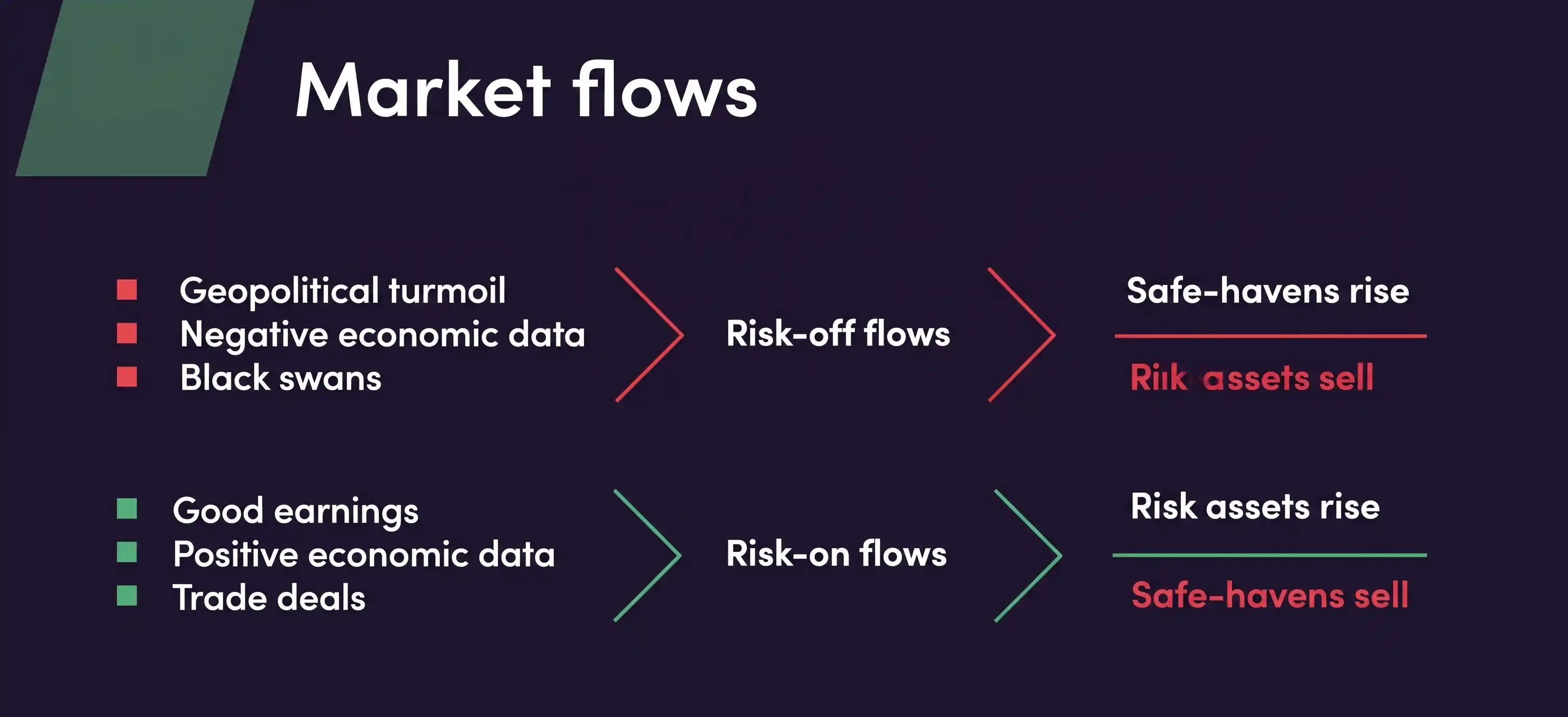
This collective judgement is called risk sentiment. It is not a single indicator or a single data point. It is the aggregate mood of global markets, reflected simultaneously across equities, commodities, bond yields, volatility measures, and currency pairs. When sentiment is positive, the market is in risk on mode: growth-sensitive assets rise, commodity currencies strengthen, and safe haven currencies weaken as capital moves into higher-returning positions. When sentiment turns negative, the market enters risk off mode: equities fall, bond yields drop as investors buy safety, commodity currencies weaken, and safe haven currencies surge.
For forex traders, risk sentiment matters because it is one of the most powerful forces capable of moving a currency in the short term regardless of what the fundamental data shows.
How Does It Work?
Risk on conditions
When risk appetite is strong, the dominant capital flow is away from safety and toward return. Equities rise. Commodity prices tend to firm. In currencies, the beneficiaries are those associated with growth, commodity exports, or high interest rates. The Australian dollar, New Zealand dollar, and Canadian dollar are among the most risk-sensitive currencies in forex. These economies are tied to commodity exports and global trade, and their currencies tend to strengthen when global growth expectations are positive and commodity demand is rising.
Risk off conditions
When risk appetite falls, the dominant flow is into perceived safety. Equities sell off. Gold rises. Government bond yields fall as bond prices rise on safe-haven demand. In currencies, three stand out historically as the primary beneficiaries: the US dollar, the Japanese yen, and the Swiss franc. Each responds to risk off conditions through a different mechanism, which is why they do not all move identically in every crisis.
The Japanese yen
The yen has a structural reason for its safe haven behaviour that differs from the others. Japan is a large creditor nation and the yen is a major funding currency for carry trades: investors borrow in yen at low rates to invest in higher-yielding assets globally. When risk sentiment deteriorates and those carry trades are unwound, investors must buy yen back to repay the loans, producing sharp yen appreciation. The yen's safe haven reputation is therefore primarily a function of carry trade mechanics and capital repatriation rather than straightforward safe haven inflows. This means geopolitical shocks that do not trigger carry trade unwinding may not produce yen strength in the way a financial system crisis would.
The Swiss franc
The franc benefits from genuine safe haven capital flows. Switzerland's political neutrality, its large current account surplus, and its reputation for financial stability make the franc a preferred destination for capital seeking protection during periods of global uncertainty. Unlike the yen, the franc's safe haven moves tend to reflect actual buying of Swiss assets rather than carry trade mechanics, which is why it often responds more reliably to geopolitical shocks.
The US dollar
The dollar occupies a unique and conditional position. As the world's reserve currency, it benefits from global demand for safety in most crises. However, when the crisis originates in the United States itself, the dollar may not behave as a safe haven and may instead weaken alongside other risk-sensitive assets. US energy independence has added another dimension in recent years: energy supply shocks that devastate European and Asian importers can actually benefit the dollar by insulating the US economy from the worst of the inflationary pressure.
Stock markets as a sentiment signal
Equity markets provide one of the clearest real-time reads on risk sentiment. When major stock indices are rising, investor confidence is generally high and the market is in risk on mode. When indices are falling sharply, particularly if the move is broad-based across multiple markets simultaneously, fear is driving capital toward safety. Watching a major equity index alongside AUD/USD or NZD/USD tells you within minutes whether the currency move is driven by sentiment or by a pair-specific fundamental factor.
Commodities as a sentiment signal
Rising commodity prices generally reflect strong economic demand and risk on conditions: growth expectations are positive, industrial activity is expanding, and investors are comfortable holding assets that benefit from a growing global economy. Falling commodity prices often reflect the opposite. This is one reason commodity currencies respond to shifts in sentiment before any economic data is released: the commodity price moves first and the currency follows. Gold occupies a special place here, tending to rise specifically during risk off episodes as a store of value rather than tracking general commodity demand.
The VIX as a sentiment gauge
The CBOE Volatility Index measures the implied volatility of S&P 500 options and is widely used as a real-time fear gauge. A low VIX below 15 signals complacency and risk appetite. A rising VIX signals increasing fear. Above 30, the market is in genuine stress and risk off flows tend to accelerate. When the VIX spikes, safe haven currencies typically surge simultaneously regardless of what other data is being released that day.
Sentiment and technical analysis
Risk sentiment does not replace technical analysis. It provides context for it. A bullish chart setup on AUD/USD carries a higher probability of success during risk on conditions, when the broader sentiment bid is supporting growth-correlated currencies. The same setup may struggle or fail entirely during risk off conditions, when sentiment is actively selling everything in the same category regardless of how clean the technical picture looks. Knowing the sentiment environment before trading any technical setup improves both the quality of entries and the willingness to hold a position through normal pullbacks.
Safe haven status is conditional
The single most important nuance in understanding risk sentiment is that safe haven status is not permanent or universal. Different crises produce different safe haven patterns depending on the source and nature of the shock. A financial system crisis tends to benefit the yen most, through carry trade unwinding. A geopolitical shock in the Middle East tends to benefit the franc more than the yen. A US-specific policy shock may actually weaken the dollar. Reading which safe haven is responding to which type of crisis is more accurate than assuming all three move the same way in every risk off environment.
Example
The February 28, 2026 geopolitical shock produced a textbook illustration of how risk sentiment moves markets and how different safe haven currencies respond differently to the same event. All data is confirmed by Babypips published analysis from March 9, 2026.
| Risk Sentiment Event | Detail |
| Event | Operation Epic Fury (US-Iran military operation) |
| Date | 28 February 2026 |
| Trigger | Oil surged 7%+ on Strait of Hormuz disruption fears |
| USD/DXY reaction | DXY surged past 98.27 (highest in over a month) |
| EUR/CHF reaction | Crashed to 0.9030 (franc's strongest vs euro since 2015) |
| USD/JPY reaction | Pushed above 157.75 (yen weakened despite the panic) |
| Source | Babypips (9 March 2026) |
The event triggered an immediate risk off response. Oil surged on Strait of Hormuz fears. Equities sold off. Capital moved toward safety. But the three traditional safe havens behaved very differently.
The Swiss franc saw the most dramatic safe haven move. EUR/CHF crashed to 0.9030, the franc's strongest level against the euro since 2015, as capital genuinely sought Swiss stability in a geopolitical shock involving energy supply disruption. The dollar surged as well, with the DXY pushing past 98.27, reflecting both safe haven demand and the conditional benefit the dollar derives from US energy independence.
The yen did the opposite of what many expected. USD/JPY pushed above 157.75, meaning the yen weakened despite the global panic. The geopolitical shock in the Middle East did not trigger the carry trade unwind that typically produces yen appreciation. Without that mechanism, the yen's safe haven effect did not materialise. Three safe havens. Three different reactions. Same event. That is what conditional safe haven behaviour looks like in practice.
Why It Matters
Risk sentiment matters because it is one of the few forces capable of overriding everything else simultaneously. A trader who is long EUR/USD on a valid fundamental thesis, with correct rate differential analysis and a clean technical setup, can still see the position move sharply against them if a geopolitical shock sends the dollar higher and all EUR-correlated assets lower at the same time. The fundamental thesis has not changed. The sentiment environment has.
Understanding sentiment also helps with timing. When sentiment is strongly risk on, pullbacks in risk-correlated currencies tend to be shallower and shorter because the underlying bid from appetite is supporting the direction. When sentiment is deteriorating, the same pullbacks can extend further and last longer because there is no sentiment bid to arrest the move.
Sentiment also explains apparent market irrationality. A strong CPI print that would normally strengthen the dollar may produce a muted reaction if the broader sentiment environment is strongly risk on and the dollar is being sold as a safe haven funding currency. The data has not changed. The market context has. For a deeper look at how to adjust position sizes and stop placement when sentiment shifts override the fundamental picture you are trading, read Risk Management alongside this topic.
Common Mistakes
| Mistakes | Why It Matters |
| Mistake 1: Assuming USD always rallies in risk off | The dollar is a conditional safe haven. In a US-specific shock, such as a domestic policy crisis or a deep US recession, the dollar may fall alongside equities rather than rising with safe haven flows. The source of the risk off episode determines which safe haven benefits most. Always identify the origin of the shock before assuming which currency will benefit. |
| Mistake 2: Assuming JPY responds the same way in every crisis | The yen's safe haven behaviour is primarily driven by carry trade unwinding, which is triggered by financial stress and volatility rather than by all types of geopolitical shock. A Middle East conflict that drives oil higher and pushes AUD up may actually weaken the yen. Understanding the mechanism behind the yen's safe haven status prevents being caught wrong-footed in events like the February 2026 episode. |
| Mistake 3: Fighting risk sentiment with fundamental data | A currency with strong fundamental backing can and will underperform during a genuine risk off episode. Trying to hold a long position in a risk-sensitive currency because the fundamental thesis is intact while sentiment is actively selling everything in that category is a trade against the dominant market force. Sentiment tends to win in the short term. |
Quick Summary
- Risk sentiment describes global market appetite for risk. In risk on conditions, capital flows toward growth-sensitive assets and higher-yielding currencies. In risk off conditions, capital moves to perceived safety. This shift can override fundamental data entirely in the short term.
- Safe haven currencies, primarily the USD, JPY, and CHF, each respond differently to different types of crisis. The franc attracts genuine safe haven capital. The yen responds primarily to carry trade unwinding. The dollar is conditional. Identifying which mechanism applies to the current shock is more accurate than assuming all three behave identically.
- Risk sentiment interacts with fundamentals: it amplifies good fundamental trends in risk on environments and overrides them in risk off environments. Stock markets, commodity prices, gold, and the VIX all provide real-time signals about which environment is currently dominant.
Next Steps
You now understand the mood of global markets and how it affects currency flows independently of economic data. The next step is a more precise analytical tool for assessing which currencies are genuinely performing.
Currency Strength - Learn how to measure the relative performance of individual currencies across multiple pairs, identify which currency is driving a move in any given pair, and use strength analysis to improve the timing of your entries and exits.
What Moves the Market - Revisit the broader forces that drive price and see how risk sentiment connects to the full picture of fundamental analysis alongside rates, inflation, and economic data.
Take Action
Choose one trading day and observe four things simultaneously: a major stock index such as the S&P 500, the gold price, the US Dollar Index, and USD/JPY. Ask yourself whether the market is showing risk on or risk off behaviour, then compare those observations with the movements in AUD/USD, NZD/USD, and EUR/CHF across the same session. Note which currencies strengthened and which weakened, and whether the pattern matched a risk on or risk off environment. Then find the VIX reading for that day and check whether it was rising or falling. Over time this daily observation builds an intuitive feel for which environment the market is in before any data is released. Practice reading risk sentiment alongside the economic calendar on a demo account before using it to inform live trading decisions.


