




- Published on: 2026-09-19 15:40:00
How Support and Resistance Can Improve Trade Planning
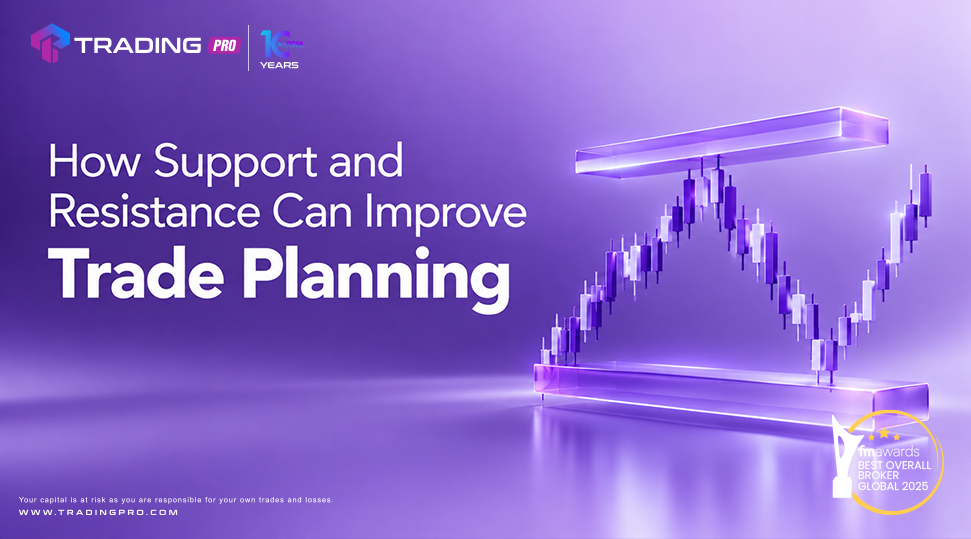
Understanding where buyers and sellers may become more active is an important part of technical analysis. Two of the most widely used concepts for this purpose are support and resistance.
These levels can help traders organize their charts, identify areas of interest, and plan potential entry and exit points. For MENA traders, the same principles can be applied across different markets and timeframes.
However, support and resistance should not be treated as exact prices that guarantee a reversal. They are better understood as areas where price may react.
What Is Support?
Support is an area on a chart where buying pressure has previously been strong enough to slow or stop a decline in price.
When price approaches a support area, some traders may expect buyers to become more active. As a result, price may stabilize or move higher.
However, support can eventually break if selling pressure becomes stronger. This is why traders should avoid assuming that every support level will hold.
What Is Resistance?
Resistance is an area where selling pressure has previously been strong enough to slow or stop an upward price movement.
When price approaches resistance, some traders may decide to take profits or open short positions, depending on their strategy and the market they are trading.
If buying pressure remains strong, however, price can break above the resistance area. Once again, the level should be viewed as an area of potential reaction rather than a guaranteed turning point.
How Traders Identify Support and Resistance
Previous Price Reactions
One of the simplest ways to identify these levels is by looking at previous areas where price repeatedly changed direction or slowed down.
If price has reacted around a similar area several times, traders may consider it a potentially important level.
The more clearly price has reacted around an area, the more attention it may receive from technical traders.
Previous Highs and Lows
Previous highs and lows can also provide useful reference points. A previous high may act as resistance, while a previous low may become support.
These levels can help traders understand the structure of the market and identify areas where price could face a reaction.
Psychological Price Levels
Round numbers can sometimes attract attention because traders naturally use them as reference points. Depending on the market, levels ending in numbers such as 00 or 50 may receive additional attention.
However, psychological levels should still be considered alongside actual price action rather than used independently.
Why Support and Resistance Matter for Trade Planning
Support and resistance can help traders define their plans before entering a position. Instead of deciding what to do while the market is moving quickly, traders can identify important areas in advance.
For example, a trader may wait for price to approach a support area and then look for confirmation before considering a trade. Another trader may watch resistance and wait to see whether price breaks above it or moves lower.
This approach can make decision-making more structured because the trader has already identified the conditions they want to see.
Support and Resistance in MENA Markets
MENA traders can apply support and resistance analysis to different instruments, including currencies, commodities, indices, and other financial markets.
For example, traders following energy markets may use previous highs and lows to identify important price areas. Similarly, currency traders can use support and resistance when analyzing major pairs or other instruments available through their trading platform.
The concept remains the same, although the strength and reliability of levels can vary depending on the market and timeframe.
What Happens When a Level Breaks?
A support or resistance level can sometimes be broken when buying or selling pressure becomes strong enough.
When this happens, traders often watch the price action that follows the breakout. A move above resistance, for example, may continue if buyers remain in control. In some cases, price may return to the previous resistance area before continuing.
Similarly, a broken support level may later become an area of resistance.
This is one reason traders often wait for confirmation instead of reacting immediately to a brief movement through a level.
Common Mistakes to Avoid
One common mistake is drawing too many support and resistance levels on a chart. When every small price movement becomes a level, the chart can become difficult to interpret.
Another mistake is treating levels as exact lines. In reality, markets can move slightly above or below an area before reversing.
Traders should also avoid assuming that a level will always hold because it worked in the past. Market conditions change, and previous reactions do not guarantee future results.
Combining Support and Resistance With Other Analysis
Support and resistance can become more useful when combined with other technical tools. Traders may use trend analysis, candlestick patterns, or indicators to look for additional confirmation.
For instance, a trader might identify a support area and then check whether price action shows signs of weakening selling pressure. This does not guarantee a successful trade, but it can provide more context than relying on the support level alone.
The goal is to build a trading decision around several relevant factors rather than one isolated signal.
Conclusion
Support and resistance are simple but useful concepts that can help traders understand price structure and plan potential trades.
For MENA traders, these levels can be applied across different markets and timeframes. By treating them as areas of potential reaction, waiting for confirmation, and combining them with broader technical analysis, traders can use support and resistance as part of a more disciplined trading process.
Start Your Trading Journey with TradingPRO
Ready to take the next step in your trading journey? Visit TradingPRO to register your account and connect with TradingPRO across our social media channels.


