




- Published on: 2026-11-17 18:01:59
Risk per Trade: How Much Should a Rookie Trader Risk
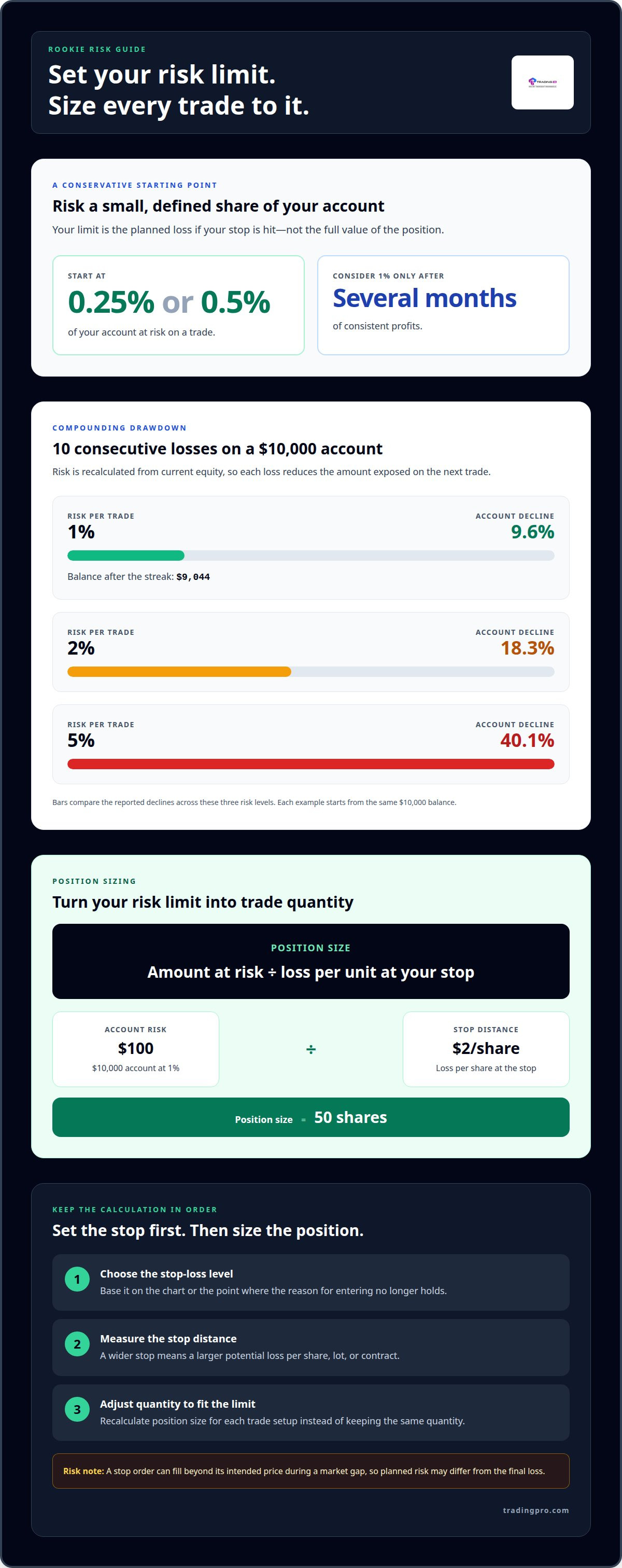
A rookie trader’s risk-per-trade percentage rule should start conservatively: begin with 0.25% or 0.5% of your account at risk on a trade, and consider increasing to 1% only after several months of consistent profits. That limit applies to the planned loss if your stop is hit, not the full value of the position.
It’s tempting to focus on how much a trade could make. But controlling what you could lose gives you more room to learn and follow a strategy through setbacks. Even a modest percentage can add up across a losing streak: ten consecutive losses at 1% risk per trade would leave a $10,000 account with $9,044, a 9.6% decline.
This guide explains how to choose a risk limit, calculate position size from your stop-loss distance, and see how repeated losses affect your balance. It also shows why the same percentage can mean very different dollar risks depending on account size and trade setup.
Key Takeaways
- Set your stop-loss level from the trade setup, then adjust position size so a stop-out stays within your chosen risk limit.
- Use the distance to your stop and the amount you’re willing to lose to calculate position size, rather than choosing size first.
- Assess both win rate and average win relative to average loss; a high hit rate alone doesn’t show whether a strategy is profitable.
- Account for losing streaks when setting risk. Larger losses take disproportionately larger gains to recover.
- Choose a per-trade limit you can apply consistently, and treat it as a risk-control tool, not a guarantee of profit.
Rule 2: How do you calculate position size?
Position size turns your account risk limit and stop distance into a trade quantity. This calculation sets the planned loss, not the total capital committed to the position.
Use this formula: position size equals the amount at risk divided by the loss per unit at your stop. For example, a $10,000 account risking 1% sets a $100 loss limit. If a stock’s stop is $2 per share away, sizing gives 50 shares. The European Securities and Markets Authority (ESMA) reports that 74% to 89% of retail CFD accounts lose money, underscoring why risk calculations matter.
Sizing Positions From Account Balance
Account balance sets the dollar amount behind your chosen risk percentage, which then informs position size. A $1,000 account risking 1% puts $10 at risk; a $10,000 account at the same percentage puts $100 at risk.
That difference matters because the same position can represent very different account risk. Calculate the risk amount from your current account capital before deciding trade quantity. For an account with $10,560 in equity, 1% risk equals $105.60. Keep the percentage consistent, then adjust each position to fit its own stop distance.
Using Stop Distance to Set Position Size
Stop distance is how far the market can move against your entry before reaching your planned exit. A wider stop increases the potential loss per share, lot, or contract, so reduce position size to keep the dollar risk within your limit.
For instance, a $100 risk limit with a $2-per-share stop allows 50 shares. If the stop distance changes, recalculate rather than keeping the same quantity. In a forex example, a 25-pip EUR/USD stop on a standard lot, with a $10 pip value, creates $250 of risk per lot. A $100 limit gives a position size of 0.4 lots.
Setting a Stop-Loss Before Sizing
Set a stop-loss based on the chart or the reason for entering, then calculate position size. The stop marks where the trade idea no longer holds. Choosing it after sizing the position can distort the risk you intended to take.
For example, identify the trade’s invalidation level first, measure the distance from entry, and divide your dollar risk by the loss per share or contract. If the setup calls for a $2 stop and the risk budget is $100, the calculation allows 50 shares. A stop order can still fill beyond its intended price during a market gap, so planned risk may differ from the final loss.
Adjusting Position Size Across Trading Styles
For day trading and swing trading, the 1% rule limits the planned loss on a single trade to 1% of account capital. The percentage does not change by style; the stop distance and resulting position size do.
Forex uses the same account-risk calculation, but sizing must account for the stop in pips and the pip value. A 30-pip EUR/USD stop on a $1,000 account risking 1% corresponds to approximately 0.03 lots. Before applying the calculation, use the account setup information to understand the capital available for trading.
Is risk-reward or hit rate more important?
For beginners, a 1:2 risk-to-reward ratio is a practical framework: risk 1% of account equity to target a potential 2% gain. The ratio helps define a profit target against the stop loss, but it doesn’t determine whether a trading strategy will be profitable.
Hit rate is the proportion of trades that win. Risk-to-reward compares the average potential gain with the amount at risk. Neither measure tells the whole story: a high win rate can still lose money if average losses outweigh wins, while a lower win rate can be profitable if winning trades are larger.
Break-even math makes the trade-off clear. Before fees and spreads, a 1:2 risk-to-reward ratio requires a 33.3% win rate to break even. At 1:3, the break-even win rate is 25%. These figures assume the average win and loss match the planned ratio. Slippage, commissions, and exits that differ from the plan can change actual results.
Four winning trades at that target would return $6,000 before losses and trading costs. But the calculation doesn’t mean four wins will occur, or that a strategy will produce those results consistently. It shows how reward size affects the number of wins needed to offset losses.
Accounts whose average winning trade exceeded twice their average losing trade were profitable at a rate of 44.6%. These are distinct account groups, not a direct comparison of identical strategies. The figures show that win frequency alone doesn’t describe the full performance picture.
Review both measures together. Track winning and losing trades, then compare average win, average loss, and hit rate. If losses average twice the size of wins, for instance, even a strong hit rate may not protect your equity. Position sizing sets the amount exposed; the ratio and hit rate help you assess how outcomes affect it.
Choose a reward target that fits the setup rather than forcing a ratio onto every position. A planned 1:2 trade needs a realistic target and a stop loss placed where the trade idea is invalidated. Use the trading account registration to put a defined risk-and-reward framework into practice.
Compounding losses and account drawdowns
A losing streak reduces the equity available for later trades, so fixed percentage risk also shrinks in dollar terms. On a $10,000 account, risking 1% of current equity for each trade leaves $9,044 after ten consecutive losses, a 9.6% decline. The loss is smaller than a straight $1,000 subtraction because each later risk amount falls with the balance.
Higher risk accelerates the drawdown. On the same $10,000 starting balance, ten consecutive losses at 2% risk per trade reduce the account by 18.3%. At 5% risk, the loss reaches 40.1%. The percentage at risk applies to the account’s current equity, so each loss changes the dollar amount exposed on the next trade.
Recovery takes more than earning back the dollar amount lost. After a 10% account loss, an 11% gain is needed to return to the starting balance. A 50% loss requires a 100% gain on the remaining balance; a 75% loss requires a 300% gain. The deeper the drawdown, the larger the return needed to restore the original equity.
Risking 5% per trade can make that recovery harder: after ten consecutive losses, the account is down 40.1%, and a 67% gain is required to recover. At 10% risk, ten consecutive losses leave $3,487 from a $10,000 account, a 65.1% loss. Recovering from that drop requires a 187% gain. A favourable reward ratio cannot erase a drawdown by itself; actual wins must cover accumulated losses.
Leverage can magnify dollar exposure beyond the amount deposited. With $10,000 in an account and 5x leverage, a $50,000 position loses $1,000 if the market moves 2% against the trader. That move equals 10% of the account’s starting balance. Calculate position size around the planned loss, and include the leveraged position’s full price exposure in your risk assessment.
Set a maximum loss limit before trading, then reduce position size as equity declines. For example, a 2% risk-per-trade approach loses 18.3% after ten consecutive losses, requiring a 22.4% gain to recover. Tracking each trade’s dollar risk and resulting drawdown shows whether the strategy remains within your chosen limits.
Keep your risk rule consistent during both losing and winning periods. Increasing risk to recover quickly raises the amount exposed while your equity is already lower. Set a written maximum, define your stop-loss, and size positions based on current equity so you know the planned exposure before entering.
How much should you risk per trade?
Beginners can start by risking 0.25% or 0.5% per trade, then consider 1% after several months of consistent profits. A predefined limit also makes decisions easier when a strategy faces volatility or a losing streak.
Benefits of Predefined Trade Risk
Predefined trade risk is the portion of account capital you decide to put at risk before entering a position. It gives each trading decision a clear boundary, rather than letting excitement or fear determine how much you expose.
That boundary supports consistent execution. You can assess a setup, place the stop, and size the position around the same risk rule instead of increasing exposure after a win or changing it impulsively after a loss. A written limit also gives your strategy a stable basis for reviewing results. If you document 100 trades, you can examine whether the approach showed positive expectancy without changing risk rules midstream.
Consistency matters because risk management is not an entry or exit signal. It sets the amount at stake; your strategy determines whether a trade qualifies. Keep the limit consistent across similar setups, and record the reason for any deliberate adjustment. This creates a clearer trading record than decisions made under pressure.
Psychological Effects of Smaller Losses
Smaller planned losses can make it easier to follow the next valid setup after a trade closes at its stop. A trader who risks 0.25% or 0.5% has less capital exposed on each position than one risking 2%. That can reduce the urge to recover a loss immediately through a larger, unplanned trade.
After a losing streak, follow your review process instead of raising risk to recover lost equity. Check whether each entry followed your strategy, whether the stop matched the setup, and whether position size stayed within your limit. This helps distinguish a valid losing outcome from a decision that broke your rules.
For beginners, 1% is a possible next step after several months of consistent profits, not an automatic starting point. Consider 2% only after at least 100 documented trades show positive expectancy. A smaller limit remains useful during volatility or while you’re still learning to execute consistently; the goal is disciplined decisions, not a bigger risk figure.
Common risk-per-trade percentages
Common limits range from 0.5% to 2% of account equity on a single trade. For a rookie, the useful choice isn’t the highest percentage available. It’s a limit that fits the strategy, account size, and tolerance for a losing streak.
0.5%: A conservative setting reduces the dollar impact of each losing trade. On a $10,000 account, that equals $50 of planned risk. This smaller exposure can suit a trader still learning to follow a strategy or navigating volatility.
1%: This is a common starting guideline for beginners. It also keeps the planned loss within 1% of account capital per trade. On a $50,000 account, the maximum planned loss is $500. The same percentage produces a different dollar amount as equity changes.
2%: This higher limit means more exposure on each position. On a $25,000 account, the maximum planned loss is $500 per trade.
Some traders choose less than 0.5%; others use 2% for selected setups. A higher win rate alone doesn’t justify increasing risk. A strategy with frequent wins can still have losing trades large enough to create a drawdown. Judge risk alongside average win, average loss, and the number of trades taken.
The 3-5-7 rule offers another framework: cap risk at 3% per trade, keep total exposure under 5%, and aim for winners at least 7% larger than losers. These are separate limits within one approach. They don’t replace position sizing or guarantee that a trade will reach its target.
To choose a percentage, consider how a run of losses would affect your decisions and account equity. A $5,000 account using a 2% limit allows a $100 maximum planned loss per trade. If that amount would push you to abandon your strategy or trade impulsively, a smaller percentage may be more workable.
Set one limit, apply it consistently, and review results across documented trades before changing it. Keep the planned risk separate from the position’s full market value. For a practical next step, set up a trading account and put your chosen risk limit into practice.
TradingPRO: Rookie Account
TradingPRO offers a Rookie Account for traders beginning to put risk principles into practice. Consider it alongside your trading plan: set your per-trade limit, understand position sizing, and choose the account tier that fits your current approach. TradingPRO also offers Micro, Pro, and Scalp Accounts to suit different trading needs.
Your risk plan remains your responsibility, whatever account you choose. Set your maximum planned loss before entering a trade, and use stop distance to guide position size. Contact TradingPRO to discuss the Rookie Account and your trading plans.
Make risk discipline your next trading habit
A rookie trader’s risk-per-trade percentage rule is most useful as part of a repeatable process, not a number you choose once and forget. Treat each trade as an opportunity to practise measured decision-making: follow your plan, record the outcome, and review whether your actions matched your strategy. Over time, those records can reveal where your process needs adjustment.
Focus on consistency rather than trying to recover losses quickly or increasing exposure after a winning trade. A disciplined approach gives you a clearer basis for refining your decisions as you gain experience. Put your trading plan into practice with an account that fits your approach.
Get started with TradingPRO and keep building your trading discipline, one considered decision at a time.
Frequently Asked Questions
Are the 1% and 2% risk rules good advice?
They can be useful guidelines, but neither percentage suits every trader or strategy. The 1% rule sets a smaller planned loss per position than the 2% rule, which can make a difference across repeated trades. Consider your strategy’s results, trade frequency, and ability to follow your plan during a drawdown. Treat either percentage as a starting point for a consistent risk process, not a guarantee of profitable trading.
Does risking more per trade lower your chances of being profitable?
Risking more does not automatically make a trade more likely to win, but it increases each outcome’s impact on account equity. If a strategy has no positive expectancy, raising risk will not create one. If it does have an edge, larger exposure can amplify both gains and losses. Before changing your risk limit, review a documented set of trades, including losses and trading costs.
Does the 1% Risk Rule Apply to Investors?
Not necessarily. This rule concerns the planned loss on an individual trade, while investors may focus on portfolio allocation, diversification, and long-term goals. An active investor making individual trades can also use a per-position risk limit to manage downside. The appropriate approach depends on whether you are assessing a specific entry and stop or the broader mix of assets held over time.
How do you survive a losing streak?
Use the risk limit and review process you set before trading instead of increasing position size to recover losses. Compare each losing trade with your written strategy: Was the setup valid? Did you follow your entry and exit rules? Look for overlapping positions with exposure to the same market theme, too. If your execution slips, pause new trades until you can follow your plan consistently again.
Is the 1% rule too conservative?
A lower risk limit may feel conservative if you want faster account growth, but the percentage alone does not determine whether a strategy suits you. Consider how the dollar loss affects your decisions, how often the strategy trades, and how it performed during losing periods. A limit that helps you execute your plan consistently can be more useful than a larger one that encourages impulsive changes.
What percentage of trading capital should a beginner risk per trade?
A beginner can start with 0.25% or 0.5% of account capital at risk per trade. For example, 0.5% of a $10,000 account is $50 of planned risk. Keep that limit consistent while learning to execute and document a strategy. Consider moving toward 1% only after several months of consistent profits, rather than increasing risk after a single successful trade.
What is the 1% rule in trading, and how does it work?
A rookie trader’s risk-per-trade percentage rule limits the planned loss on a single trade to 1% of account capital if the stop is reached. It sets the maximum amount at risk, not the amount invested or the position’s full market value. The stop location and the instrument’s value per unit determine how many shares, lots, or contracts fit within that limit.
How do you calculate position size using risk per trade and stop-loss distance?
Divide your planned dollar risk by the loss per unit at the stop. First, calculate the account amount represented by your risk percentage. Then measure the distance between entry and stop and convert it into a loss per share, lot, or contract. For forex, include pip value; for other instruments, use the relevant unit value. Round the resulting size down to stay within your limit.


