



- Published on: 2026-11-15 11:34:20
How to Use an Economic Calendar to Track Forex Releases

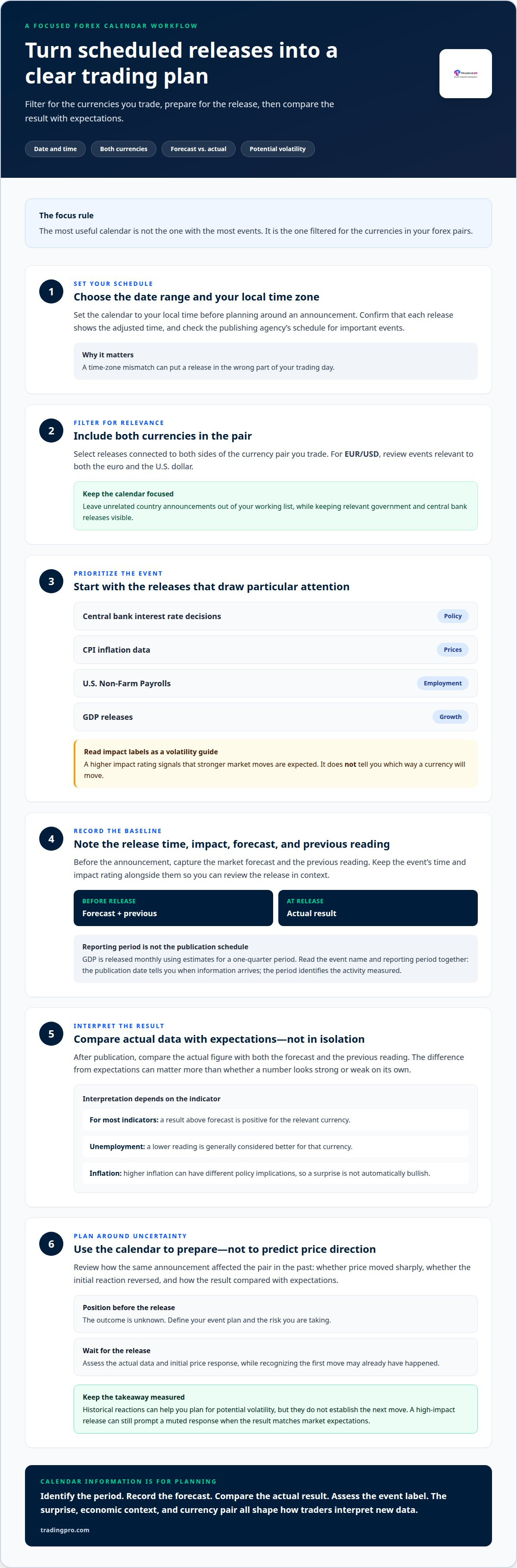
The most useful economic calendar isn’t the one with the most events. It’s the one filtered for the currencies in your forex pairs. Learning how to use an economic calendar means finding releases by date and currency, then focusing on the indicators most likely to affect those currencies.
A crowded schedule can make every announcement seem important. Instead, match each release to the countries behind the pairs you trade, convert its time to your time zone, and note its impact rating, forecast, and previous reading.
This guide shows you how to find scheduled releases, prioritize interest rate decisions, inflation data, employment reports, and GDP figures, and compare actual results with expectations. You’ll also learn to treat calendar details as planning information, not a promise of how prices will move. Build a focused routine, prepare for potential volatility, and make each release relevant to your trading decisions.
Key Takeaways
- Match calendar events to both currencies in your pair so country-specific news stays relevant to your trading plan.
- Use the release time, impact rating, forecast, and previous reading to prepare for events that may move the market.
- Compare the actual result with expectations; the difference can matter more than whether the figure looks strong or weak on its own.
- Prioritize interest rate decisions, inflation, employment, and growth data, while remembering that indicators can be revised or tell only part of the economic story.
- Use calendar information to plan around potential volatility, not as a prediction of the direction or size of a price move.
Are Economic Indicators Released Quarterly?
No. Release frequency depends on the indicator: GDP is released monthly, using estimates for a one-quarter period. To assess an announcement’s potential market effect, compare its actual result with the market expectation and check the event’s impact rating.
- Check the release frequency and period. Don’t assume every indicator follows a quarterly schedule. GDP, for example, is published monthly while estimating activity across a one-quarter period. Read the calendar’s event name and reporting period together: the publication date tells you when the information arrives, while the period identifies the activity measured. This distinction helps you avoid treating a quarterly estimate as a release published only once per quarter.
- Compare actual data with the forecast. Before an announcement, note the consensus expectation and previous reading. After publication, compare the actual figure with both. For most indicators, a result above forecast is positive for the relevant currency, but the indicator’s meaning matters. For example, a lower unemployment reading is generally considered better for that currency. Higher inflation can have different policy implications, so don’t interpret every surprise as automatically bullish.
- Read impact labels as a volatility guide. Economic calendars often label events by expected impact or importance. A higher-impact rating signals that stronger market moves are expected, not which way a currency will move. Central bank interest rate decisions, CPI inflation data, U.S. Non-Farm Payrolls, and GDP releases tend to attract particular attention. Use the label to identify announcements that may need closer monitoring, then consider both currencies in the pair and the forecast before planning your trade.
- Study previous reactions before planning around a release. Review how the same announcement affected the relevant currency pair in the past. Note whether price moved sharply, whether the initial reaction reversed, and how the actual result compared with expectations. Historical reactions can help you plan for potential volatility, but they don’t establish the direction of the next move. A high-impact release can still prompt a muted response when the result matches market expectations.
Use these steps together: identify the reporting period, record the forecast, compare the actual result, and assess the event label. The calendar helps you organize scheduled announcements and prepare for possible volatility. It can’t tell you the market’s response in advance: the surprise, economic context, and currency pair all shape how traders interpret new data.
Finding scheduled economic releases by date and currency
Start with the date range, then narrow events to currencies connected to your forex pairs. Free calendar websites and apps are useful if they show release times, currencies, forecasts, previous readings, and impact labels. Compare schedules with the relevant agency’s releases. Learning how to use an economic calendar well starts with setting its time display to match your schedule.
-
Set the Calendar Time Zone
Choose your local time zone in the calendar settings before planning around an announcement. Then scan the selected date and confirm each release shows the adjusted time, not a different region’s local time. A time-zone mismatch can put an event in the wrong part of your trading day. Check the calendar again if your schedule or location changes, and compare important release times with the publishing agency’s schedule. This keeps your plan aligned with when the data is due, rather than when another market expects it.
-
Filter Releases by Currency
Select the currencies in the pairs you trade, then review events connected to both sides. For EUR/USD, for example, focus on releases relevant to the euro and U.S. dollar, since developments tied to either currency can affect the pair. Avoid tracking every country’s announcements if they have no clear connection to your positions. Keep relevant government and central bank releases visible, then use the event name and impact label to prioritize your review. Calendar filters help you build a focused list without overlooking scheduled events for either currency.
To build a calendar around agency releases, identify the government statistics offices and central banks responsible for data affecting your currencies. Their published schedules help you check recurring announcements and spot dates to add to your routine. A calendar app can bring those events together by date and currency. Keep agency schedules and calendar entries aligned, especially if an announcement’s date or time changes. This makes your calendar a practical trading reference, not a feed of unrelated news.
-
Plan Around Release Timing
Decide in advance whether to manage a position before a release or wait for post-release momentum. Pre-release positioning means acting while the outcome is unknown, so you need a clear plan for the event and the risk you’re taking. Waiting lets you assess the actual data and initial price response, but the first move may already have happened. Neither approach guarantees a better result. Mark the event time, define what would change your view, and don’t treat a forecast as the announcement itself.
After publication, watch how the market responds to the actual figure and whether movement continues or reverses. A release can trigger volatility, while the currency pair’s response depends on the result and what traders expected. If you use Social Trading or Copy Trading, consider how scheduled releases fit your approach before deciding whether to follow a strategy. Understanding how to use an economic calendar also means connecting its schedule to your own trading decisions. For a structured next step, start a TradingPRO account and apply your calendar routine to your trading decisions.
Economic indicators relevant to forex traders
Sort scheduled indicators by what they measure, when they arrive, and how they relate to a currency’s economy. This helps connect releases to monetary policy and market expectations.
-
Identify Relevant Economic Indicators
Start with indicators that can shape expectations for an economy and its interest rate path. Central bank decisions, inflation data, employment reports, and GDP releases can all matter to forex traders. Check the calendar’s event name, reporting period, forecast, and previous reading. Then focus on the currencies in your pairs rather than tracking unrelated announcements.
Classify each indicator by its economic role. Consumer confidence indexes and housing permits are leading indicators, offering clues about future activity. Unemployment rates and consumer price indexes are lagging indicators, reflecting conditions that have already developed. Industrial production and retail sales are coincident indicators, giving a view of current economic activity. This classification helps explain why different releases may affect expectations at different times.
-
Interpret Unemployment Indicators
Read the unemployment rate alongside employment changes, market consensus, and any revisions. A lower unemployment reading is generally considered better for the currency concerned, but one figure alone may not explain the full labor picture. Compare the result with expectations and review related employment details before deciding what the release may imply for economic momentum or monetary policy.
The U.S. Bureau of Labor Statistics reported that total nonfarm payroll employment increased by 304,000 in January 2019, while the unemployment rate edged up to 4.0 percent. The contrasting figures show why traders should examine more than one headline. The employment gain and the unemployment rate moved in different directions, so a quick reading of only one figure could miss useful context.
- Match release frequency to the reporting period. The U.S. Bureau of Labor Statistics releases employment situation data monthly, so track its schedule when following U.S. labor conditions. GDP is released monthly using estimates for a one-quarter period. A monthly publication can therefore describe a longer reporting window. Check both the event date and the period covered before comparing readings or interpreting a change.
Use the calendar’s cadence to organize analysis, not to assume every indicator updates at the same pace. Monthly employment and inflation releases can provide new evidence between GDP estimates. Measures covering a quarter can offer a broader view of growth. When a scheduled release arrives, compare its actual result with consensus and previous data, then consider whether revisions or related indicators change the overall picture. This keeps the indicator’s timing and meaning in view.
What Is the Economic Calendar?
An economic calendar organizes scheduled reports and announcements that may affect prices. Use its country, time, impact, and category details to turn a crowded schedule into a focused trading plan.
Economic data releases publish measurements such as employment or inflation. Central bank events include interest rate decisions and policy statements, which can influence expectations for future rates. Both can move currencies, but they provide different information.
Check the calendar before trading and review it again before a scheduled event. This gives you time to identify relevant announcements, consider volatility, and adjust your plan without treating a forecast as a result.
- Filter first by country. Select countries connected to the currencies you trade, then narrow the view by impact rating. For EUR/USD, for example, prioritize euro-area and U.S. events over unrelated country reports. A high-impact label signals that stronger market movements are expected, not that a particular direction is certain. Keep lower-impact entries visible when they provide useful context for a major release.
- Use categories to make the schedule easier to scan. Some calendars provide 12 event categories for filtering. Select categories tied to your analysis, such as employment, inflation, or central bank decisions. Calendars may also include political elections, fiscal policy changes, and international trade agreements. These news events can add context to economic reports, but separate them from scheduled data releases so you understand what kind of information is due.
- Read each event description and displayed time. Calendar entries can show a country, release time, impact level, market consensus, and previous reading. Some calendars display events in local time, so confirm which time zone the schedule uses before planning your trading day. Read the event description carefully: it identifies the indicator or announcement and may clarify the reporting period. That context helps prevent confusion between publication time and the period measured.
- Plan for volatility rather than predicting a result. Use high-impact events to identify periods when markets may become more volatile. Before the announcement, decide whether your strategy calls for holding a position, reducing exposure, or staying out. A calendar can help you plan around possible risk, but it can’t tell you how prices will respond. After publication, compare the actual report with the forecast, then assess whether the market’s movement supports your analysis.
- Build a review routine around your trading schedule. Scan upcoming events when planning trades, then revisit relevant entries before acting. This helps you catch scheduled announcements without monitoring every country throughout the day. Keep the country filters, categories, and time display consistent across reviews. A clear routine makes it easier to connect an event with the currency pair and position under consideration.
Forex calendars and currency-pair countries
A forex calendar is more useful when its events connect directly to both currencies in a pair. Build your view around each pair’s countries, then prioritize announcements that could shift relative expectations.
- Map each pair to its two economies. For EUR/USD, follow euro-area and U.S. events; for GBP/JPY, include the United Kingdom and Japan. A release concerning either economy can influence its currency, while the pair’s movement reflects their relative performance. In 2025, the U.S. dollar was on one side of 89.2% of forex trades. That makes U.S. announcements relevant to many pairs, but it doesn’t remove the need to track the other currency.
- Prioritize each country’s monetary and inflation signals. Add central bank decisions and inflation releases for both currencies, then consider employment and growth reports. A rate decision can affect expectations for returns in that currency; inflation may shape how investors assess future policy. Compare the event’s country and currency with your pair before drawing conclusions. For EUR/USD, a U.S. inflation surprise and a euro-area policy announcement concern different sides of the same exchange rate.
- Assess the pair, not just one currency in isolation. A strong report for one country doesn’t automatically predict a profitable trade. Ask whether the other currency has a competing release, and consider what the market expected from both economies. If U.S. data beats expectations while euro-area news shifts policy expectations, EUR/USD may respond to the contrast. Use the calendar to identify overlapping events, then decide whether your existing view still fits the information.
- Set a release plan for positions and orders. Mark relevant announcements against open positions and planned orders. Forex spreads may widen around economic data releases, creating execution risk, so account for potential volatility in your strategy. Don’t assume a stop or entry order will behave as intended in a fast market. Decide beforehand whether to hold, reduce exposure, or wait for the release and subsequent price movement to become clearer.
Turn this country-by-country view into a repeatable routine: match each pair, prioritize its economic events, and plan around release risk. Put your currency-pair analysis into practice with a trading account.
TradingPRO
TradingPRO offers forex account options for different trading approaches. Use the economic calendar to shape your release plan, then choose an account type that aligns with how you intend to trade. Rookie, Micro, Pro, and Scalp Accounts give you options to consider as you put that plan into practice.
If you’re refining your approach around scheduled announcements, focus on the currencies you trade, the events that matter, and how you’ll manage positions around them. A clear routine connects calendar analysis with your trading decisions, without treating any release as a guaranteed signal.
For a conversation about your next steps, contact TradingPRO.
Make Your Calendar Part of a Consistent Trading Routine
Make calendar review a repeatable part of your preparation. Choose the currencies you follow, identify announcements that could affect your plans, and decide how you’ll respond before the market moves. After each release, record what changed your view and what didn’t. Over time, these notes can help you refine how you use an economic calendar and build a process that reflects your trading goals.
Keep your decisions grounded in analysis, not urgency. A scheduled event gives you time to prepare, but your strategy should also account for uncertainty and changing market conditions. Make your next step deliberate: define what you want from your trading approach, then consider how your account choice supports it.
Discuss your trading goals with TradingPRO and take the next step with focus and confidence.
Frequently Asked Questions
What events should forex traders look for?
Prioritize events that could shift expectations for either currency in your pair. Central bank decisions, inflation reports, employment data, and GDP releases are common starting points. Then look beyond the headline: wage data and revisions can add context to U.S. employment reports, while core inflation can carry more monetary-policy relevance than food and energy prices. Match each event to the economic question it helps answer.
What is an economic calendar and what information does it show?
An economic calendar is a schedule of reports and announcements that may influence financial markets. Entries commonly show the relevant country, release time, event name, impact rating, forecast, and previous reading. The actual figure may appear after publication. Treat each row as a compact event record: the description identifies what is being announced, while the time and country help you fit it into your trading plans.
What do forecast, previous, and actual economic data mean?
The forecast is the market’s expected reading, often based on a median of estimates from economists surveyed by agencies such as Bloomberg and Reuters. The previous figure is the prior published reading, which may later be revised. The actual figure is the new reading published by the relevant national statistics agency or analytical center. Compare actual with forecast, then check revisions to the previous reading for added context.
How do you filter an economic calendar by country, currency, event, or impact?
Start with the currencies in your pair, then select the countries linked to those economies. Choose event categories that fit your analysis, such as inflation or employment, and use the impact filter to focus on events expected to matter more. If the calendar has a search field, use an event name to find a specific report. Confirm its displayed time zone before planning around it.
How can economic calendar events affect stocks, bonds, currencies, and commodities?
Economic releases can change expectations about growth, inflation, and central bank policy, influencing several markets at once. Interest rate expectations may affect bond prices and yields, while changing outlooks for company earnings can move stocks. Currency prices can respond as investors reassess relative economic prospects. Commodity prices may react to news affecting expected demand or supply. The direction and scale of each response depend on the event and market context.
How do traders prepare for high-impact economic news releases?
Before a high-impact announcement, identify the related market and note what outcomes would change your view. Review the forecast and your open orders, then decide whether to maintain your plan, reduce exposure, or wait. Don’t treat any expected result as certain. After the release, compare the actual figure with expectations and watch whether the initial market response continues or fades before acting.
What are the risks of trading during economic announcements, including volatility and slippage?
Fast price movements around announcements can make execution less predictable. Forex spreads may widen around data releases, increasing execution risk, and slippage can occur when an order fills at a different price than expected. A high-impact event may also trigger sharp reversals or unexpected stop-loss closures. Consider whether your trading plan can accommodate these conditions; waiting until the market settles is another option.
Which economic calendar websites and apps are reliable and free?
Use free calendar websites or apps that show release times, currencies, forecasts, previous readings, and impact labels. Check important release dates and times against the relevant government or central bank agency’s schedule.


