




- Published on: 2026-11-21 18:01:29
Beginner guide to trading session overlaps and spreads

Session overlaps don’t affect every currency pair equally. The currencies involved and the markets open at the time shape activity: the London-New York overlap is typically the most liquid period, while pairs tied to other regions may respond more during their local sessions.
It makes sense to focus on overlaps when you want more market activity, but higher activity can also bring sharper price movements. This beginner’s guide to trading session overlaps explains how session schedules influence currency pairs, liquidity, volatility and spreads, helping you make a more informed choice about when to trade.
You’ll learn what happens when major sessions run at the same time, why spreads may behave differently in active and quieter hours, and how daylight saving changes can shift overlap times. Then you can compare the session schedule with the pairs you follow and the trading conditions that suit your approach.
Key Takeaways
- Use session schedules to identify when the markets behind your currency pair are active, then account for daylight-saving changes that can shift overlap times.
- The London-New York overlap is typically the most liquid, but a busy market doesn’t tell you whether prices will rise or fall.
- Match your trading hours to the currency pair and your approach; quieter periods and active overlaps can produce different market conditions.
- Before trading an overlap, consider the spread, scheduled news and the possibility of sharper price moves.
- Explore Social Trading / Copy Trading if you want to follow other traders’ strategies as part of your approach.
How many major trading sessions are there in forex?
Forex activity is often described in broad regional sessions, including Asia-Pacific, European and North American trading. The Asia-Pacific window covers financial centers such as Sydney and Tokyo, while London represents European trading and New York represents North America. Traders also track four individual market sessions because Sydney, Tokyo, London and New York open at different times.
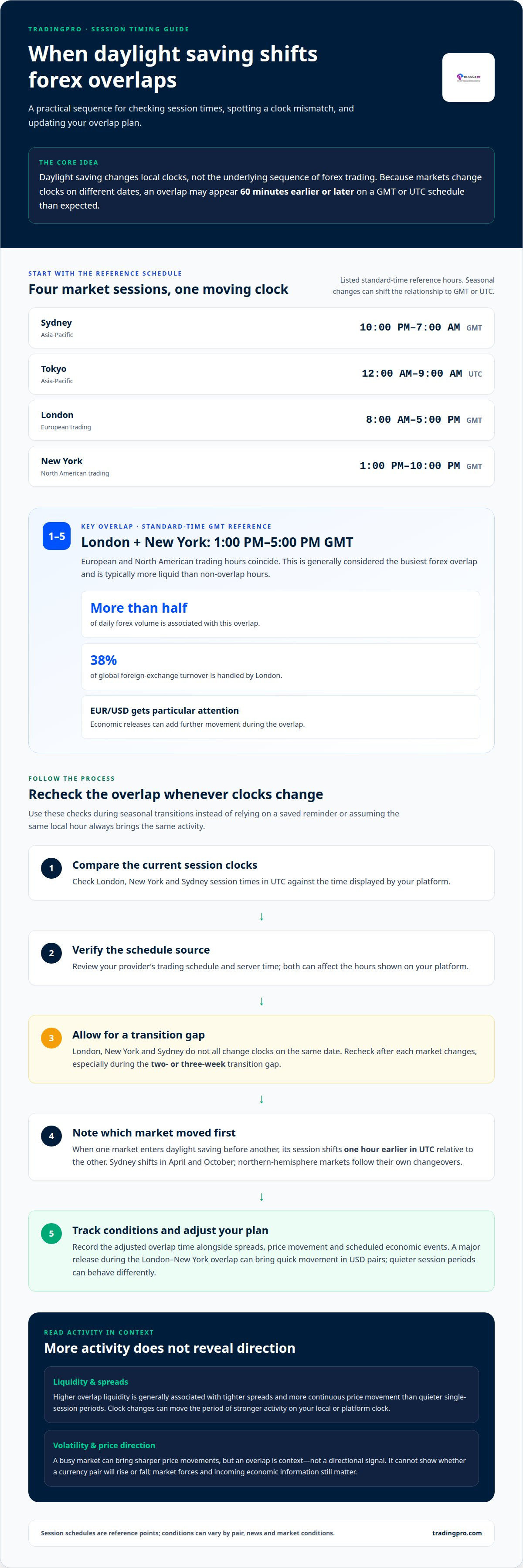
For a standard-time GMT reference, the listed hours are:
- Sydney: 10:00 PM to 7:00 AM GMT.
- Tokyo: 12:00 AM to 9:00 AM UTC.
- London: 8:00 AM to 5:00 PM GMT.
- New York: 1:00 PM to 10:00 PM GMT.
These are reference schedules, not a promise that market conditions stay constant throughout each window. Daylight saving changes can shift the relationship between local openings and GMT or UTC, so the same overlap may appear at a different clock time during transition periods.
The London-New York overlap is generally considered the busiest forex overlap. In the standard-time GMT reference, it runs from 1:00 PM to 5:00 PM, when European and North American trading hours coincide. This period is associated with more than half of daily forex volume and typically higher liquidity than non-overlap hours.
Which trading session overlaps have the highest liquidity and trading volume? The London-New York overlap generally leads, with both financial centers active at once. EUR/USD receives particular attention during this window, while economic releases can add further movement.
London also matters outside the overlap. London handles 38% of global foreign-exchange turnover, and its session can bring strong trading activity as European participants enter the market. Volatility may increase when activity builds, but it can vary by currency pair, scheduled economic news and the day’s market conditions. A quieter period can offer less movement, not a reliable forecast of the next price change.
Do trading session overlaps matter for stocks, futures, and crypto as well as forex? Overlapping activity can matter, but forex session times don’t determine every market’s schedule. Stocks and futures follow their exchanges’ trading hours, while crypto activity doesn’t map neatly onto the four forex sessions.
Use the overlap as context, not a directional signal. Two sessions operating together can increase participation and liquidity, but they can’t show whether a pair will rise or fall. For example, the London-New York overlap identifies a period to watch EUR/USD; the pair’s direction still depends on market forces and incoming economic information.
How does daylight saving affect forex session times?
Daylight saving time changes local clocks, not the underlying sequence of forex trading. The complication is that London, New York and Sydney don’t all change clocks on the same date. During the mismatch, a session overlap can appear an hour earlier or later on a GMT or UTC schedule than traders expect.
These transition gaps can shift session overlaps around seasonal clock changes. During that window, a liquidity surge associated with an overlap may arrive 60 minutes earlier or later than its usual time. A calendar saved before the change can therefore mislead traders relying on a fixed clock reminder.
The direction of the shift depends on which market changes clocks first. When one market enters daylight saving time before another, its session shifts one hour earlier in UTC relative to the other market. Australia adds a seasonal contrast: Sydney shifts in April and October, while northern-hemisphere markets follow their own changeovers.
Clock changes can affect how traders experience spreads, but they don’t determine a spread by themselves. Higher liquidity during overlaps is generally associated with tighter spreads and more continuous price movement than quieter single-session periods. If a daylight-saving mismatch changes when the overlap occurs, the period of stronger activity may also move on your local or platform clock.
Use a short schedule check during each seasonal transition:
- Compare the current London, New York and Sydney session times in UTC with your platform’s displayed time.
- Review the provider’s trading schedule and server time, since both can affect the hours shown.
- Recheck the overlap after each market changes its clock, especially during the two- or three-week transition gap.
Trading conditions can shift along with the clock. A major economic release during the London-New York overlap can bring quick movement in USD pairs; a quieter session period can behave differently. Track scheduled events and the actual overlap time together, rather than assuming the same local hour always brings the same liquidity.
For a more deliberate approach, update your session plan when clocks change and note how spreads and price movement behave around the adjusted overlap. If you’re ready to put that plan into practice, register with TradingPRO.
What Happens When Forex Sessions Overlap?
Forex trading runs across global financial centers, so activity changes as each session opens. Knowing the session times helps you put an overlap in context and understand when currency markets may become more active.
What Session Overlaps Mean
A forex session overlap is a period when two major trading sessions are open at the same time. For example, London and New York overlap from 1:00 PM to 5:00 PM GMT in the standard-time reference, or 8:00 AM to 12:00 PM ET. With European and North American participants active together, liquidity and price movement can increase. That extra activity creates opportunity to observe, not a signal that the dollar or another currency must move in one direction.
The four commonly tracked forex sessions have these listed hours:
- Sydney: 10:00 PM to 7:00 AM GMT.
- Tokyo: 00:00 to 09:00 UTC.
- London: 08:00 to 17:00 GMT in the standard-time reference.
- New York: 13:00 to 22:00 GMT in the standard-time reference.
These session windows connect the Asia-Pacific, European and North American trading day. Tokyo’s hours are listed in UTC, while the other figures above use GMT. Both provide a global time reference, but a platform may display local time or server time instead.
Finding Overlaps on Trading Tools
A market-hours calendar or platform session indicator marks the hours when named markets are open, making shared trading windows easier to spot. Beginners can identify overlaps by setting the display to GMT or UTC, then comparing the start and end times for the two sessions. For instance, London and New York share the 13:00-17:00 GMT window in the standard-time reference. Check the display’s time zone and daylight-saving adjustment before relying on that clock.
Forex market activity is commonly described as continuous for 24 hours a day, five days a week, rather than around the weekend. When the week’s trading closes, the same session overlap does not operate until trading resumes. A calendar helps distinguish active weekday hours from the weekend pause, while a session indicator shows where a pair’s relevant markets coincide. Neither tool predicts price direction; scheduled economic news can still change movement quickly during an overlap.
Choosing a session based on trading style and currency pairs
Choose market hours by matching the currencies you follow with the pace your strategy can handle. A beginner guide to trading session overlaps should help you compare those factors, not assume that the busiest window suits every trade.
Matching Sessions to Trading Styles
Your trading style can help determine whether you focus on active overlaps or quieter single-session hours. Beginners can study breakout strategies during overlaps, when increased activity may bring sharper price movement, and range trading during quieter hours. These are approaches to learn, not automatic routes to profit. Match the setup to the pair, its current movement and your ability to manage a fast-changing market.
What beginner strategies can be used during forex session overlaps? Traders can watch for a breakout from a defined range or wait for price action to establish direction after scheduled economic news. An overlap doesn’t predict direction, so decide in advance what market movement would support or invalidate the setup.
Currency Pair Activity by Session
Currency pair activity often reflects which regions’ currencies are represented in an open session. EUR/USD has historically moved more during London than during the Asian session, with typical figures of about 100 pips and 35 pips, respectively. GBP/USD also tends to be quieter in Asia, where its typical range is roughly 35-50 pips. These ranges can help compare sessions, not forecast a trade’s result.
During Sydney and Tokyo hours, traders may focus on AUD/USD, NZD/USD, USD/JPY, AUD/JPY and NZD/JPY. During the Asian-London overlap, pairs involving JPY, AUD, NZD, EUR or GBP may draw attention, depending on conditions.
Major Pairs During the US Session
The New York session can suit traders tracking USD activity and major pairs. Currency pairs to consider include EUR/USD, USD/JPY, GBP/USD, EUR/JPY, GBP/JPY and USD/CHF. GBP/USD typically moves 80-120 pips during the New York session, while its London-session range is typically 100-150 pips. Compare the active market hours with your planned trade, rather than treating a larger range as a profit target.
During the London-New York overlap, EUR/USD receives particular attention. Important US economic data released during that shared window can move USD pairs quickly, potentially affecting breakout timing and execution.
Sydney Session Pairs and Activity
Sydney’s session often brings attention to pairs containing the Australian or New Zealand dollar. AUD/USD typically has a daily range of around 30-50 pips during Sydney hours, and NZD/USD often moves within a 30-50-pip range. These examples make the session relevant for traders studying AUD and NZD activity, rather than assuming every currency pair has equal movement.
As Sydney activity connects with Tokyo, AUD/USD, NZD/USD, USD/JPY, AUD/JPY and NZD/JPY may be worth watching. Use each pair’s regional connection and your strategy to choose market hours, not as a promise of profit. This is a practical starting point for a beginner guide to trading session overlaps.
Liquidity, volatility, and spreads during session overlaps
Overlapping sessions can bring more participants and trading volume into the forex market. Consider liquidity, volatility and spreads together to understand the conditions behind a currency pair’s movement.
Overlap Effects on Liquidity and Volatility
Liquidity describes how readily traders can buy or sell without a large price change, while volatility describes how much and how quickly prices move. During the London-New York overlap, historically higher volume has been associated with stronger liquidity than quieter single-session periods. That activity can also bring sharper price movements. For EUR/USD, the pair’s daily range during this overlap can be 60-100 pips, illustrating why a busier market still requires careful risk planning.
Liquidity and volatility aren’t interchangeable. More participants can support continuous trading, yet economic news can trigger fast movement even during a liquid overlap. When important US data arrives while London and New York are open, USD pairs may move quickly. A market order can execute at a different price from the one displayed if prices shift rapidly. Focus on the pair and the event, not just the session label.
Liquidity and Spreads During Overlaps
A spread is the difference between a currency pair’s buy and sell prices. Higher liquidity during an overlap is generally associated with tighter spreads and more continuous price movement. Major pairs may have narrower spreads during active periods, so compare the spread you see with the session and pair you’re trading. A typical pattern isn’t a fixed quote for every moment.
Execution still matters. Fast price changes can mean a market order fills away from its displayed price; a stop order can also execute at a different price from its selected level. A limit order may not fill if its selected price isn’t available. These order differences matter most when rapid movement and scheduled news coincide during an overlap.
Before entering a trade, assess the spread alongside the pair’s movement and the event calendar. If a position stays open during an overlap, monitor equity, used margin, free margin and margin level. These figures show how the position affects available account resources as prices change. A tight spread alone doesn’t make a trade low-risk, and high volume doesn’t indicate whether EUR/USD or another pair will rise or fall.
- Compare the displayed spread during the session you plan to trade.
- Note scheduled economic releases that could accelerate price movement.
- Choose order types with their execution behavior in mind.
Use these checks to build a session plan around observable conditions, rather than assuming every overlap behaves alike. Register to apply a session-aware trading approach.
TradingPRO: Social Trading / Copy Trading
TradingPRO offers Social Trading / Copy Trading for traders who want to follow and replicate other traders’ strategies. This can help you observe how trading decisions unfold across different market conditions, including session overlaps. Copying a strategy doesn’t remove market risk, so consider how it fits your goals and approach before choosing it.
TradingPRO also offers Rookie, Micro and Pro Accounts. If you’re deciding how to approach forex sessions, consider whether Social Trading / Copy Trading or an account option aligns with your trading plans. For a conversation about your options, contact TradingPRO.
Turn market awareness into a trading routine
A useful next step is to turn what you’ve learned into a routine that fits your schedule and decision-making style. Use this beginner guide to trading session overlaps as a starting point, then focus on one currency pair and observe how its movement, spread and trading conditions change during the hours you follow. Keep notes on what you see and refine your approach through deliberate practice, rather than chasing every active market window.
TradingPRO’s Rookie, Micro and Pro Accounts give you options to consider as you shape your trading plans. Choose the next step that fits your approach, and ground your decisions in the conditions you can observe.
Explore your next step with TradingPRO and build your market experience with focus and confidence.
Frequently Asked Questions
Do session overlaps affect all currency pairs equally?
No. A pair’s activity depends partly on which currency markets are open and what news affects those currencies. For example, a trader watching AUD/USD may focus on Sydney and Tokyo hours, while EUR/USD often draws attention during London and New York trading. Compare the pair’s recent movement and spread during the hours you plan to trade. A busy overlap can affect pairs differently, so don’t assume one schedule fits every setup.
Can beginners trade the Asian session?
Yes, beginners can trade the Asian session by choosing pairs connected to its markets and planning around the conditions they observe. AUD/USD, NZD/USD and USD/JPY are examples traders may watch during Sydney and Tokyo hours. A quieter market can suit strategies designed for slower movement, while a sudden change in activity can alter the setup. Focus on understanding one pair’s behavior before adding more to your watchlist.
Is the forex market really open 24 hours?
Forex trading operates 24 hours a day, five days a week, as activity moves across financial centers. That doesn’t mean every pair has identical activity at every hour. For example, trading conditions can shift as Sydney, Tokyo, London and New York open, and the weekend brings a pause in the usual trading week. Use a market-hours calendar to distinguish active weekday sessions from closed-market periods.
What is the best time of day to trade forex?
There isn’t one best time for every trader or currency pair. The London-New York overlap is generally the most liquid period, which can suit traders seeking active conditions. Someone following AUD/USD may instead focus on Sydney hours. Start with the pair you understand, then compare its activity with your available trading time and strategy. Treat the calendar as a planning tool, not a signal to enter.
Does overlap always mean better trading conditions?
No. Overlaps can bring higher liquidity, but they can also bring sharper price changes, particularly around important economic releases. Spreads on major pairs may be narrower during active periods, but that isn’t assured at every moment. Before entering, consider the displayed spread, the pair’s movement and any scheduled news. A busy market can create opportunity, but it also calls for attention to execution and risk.
Market Overlaps Explained: Why They Matter in Forex Trading?
Overlaps matter because activity from two financial centers can coincide, changing the conditions traders encounter. For instance, during London-New York hours, news affecting the euro or US dollar may influence EUR/USD while both regions are active. This context helps traders decide when to observe a setup or review its spread. It doesn’t predict direction; a session schedule is useful alongside price action and economic-event timing.
What Beginners Should Check During Overlaps?
Before trading, identify the currency pair and compare its spread with the conditions you expect. Review scheduled news, trade size and the margin requirement, then decide how much account risk the setup involves. If a position is open, monitor equity, used margin, free margin and margin level. Also understand how your chosen order behaves during rapid movement, since execution can differ from the selected price.
What are the major forex trading sessions and their UTC hours?
The commonly tracked sessions are Sydney, Tokyo, London and New York. Their listed UTC hours are Sydney, 21:00-06:00; Tokyo, 00:00-09:00; London, 07:00-16:00; and New York, 12:00-21:00. These schedules show when regional trading centers are active, but daylight-saving changes can shift their relative timing. Compare the calendar’s timezone with your platform clock before planning around a specific overlap.


