




- Published on: 2026-11-15 18:01:40
5 Ways to Navigate Market Opening Volatility and Assess Risk

The opening bell isn’t a signal to trade; it’s a moment to assess what’s moving prices and how much risk you’re prepared to take. For beginners, navigating market opening volatility starts with recognizing that company, political, economic, and market developments can all cause price swings. A clear plan helps you respond deliberately instead of reacting to every early move.
Sharp moves at the open can feel urgent, especially when prices shift before you’ve had time to absorb the news. Markets rise and fall, and past performance doesn’t guarantee future results. You can make more informed decisions by understanding what volatility measures, what past market swings can and can’t tell you, and how a potential loss fits your financial comfort zone.
This guide covers five practical ways to approach market openings: understand what drives volatility, learn from historical ups and downs without treating them as forecasts, assess your risk tolerance, consider opportunities without trying to time every dip, and choose an account type that fits your trading approach. Let information, not impulse, guide your decisions.
Key Takeaways
- Use past market swings to understand how quickly conditions can change, not as a forecast of what prices will do next.
- Assess how a potential loss could affect your plans, short-term needs, and ability to stick with a strategy.
- Look beyond the opening move: company, political, regulatory, market, and economic developments can all drive volatility.
- Consider a disciplined approach to investing rather than trying to predict every dip or rebound.
- Understand what volatility measures, so you can interpret market moves with more context and make decisions aligned with your risk tolerance.
1. Markets’ historical ups and downs
Historical returns show why one market opening can’t define an investing strategy. Over the past 100 years, stocks roughly doubled every eight years, despite wars, inflation, and pandemics. Annual U.S. market returns were positive in 35 of the past 46 years, but that history doesn’t predict the next session. A hypothetical $1 invested in the MSCI World Index in 1970 grew to $99 by 2023. Treat these figures as context, not a promise about future performance.
Pullbacks can happen even in years that finish with gains. The average intra-year market decline has historically been around 14%, and double-digit declines are typical. A drawdown measures a peak-to-trough decline over a specified period, so it describes a past loss, not the next opening move. Markets are forward-looking and can bottom during recessions, before economic conditions improve. Staying invested may help avoid missing a recovery, but it doesn’t remove the risk of loss.
Premarket and extended-hours trading in the United States depends on a broker’s session access and order rules. Eligible orders may execute only when a matching buyer or seller is available, and lower liquidity can make execution less predictable than during the regular session. Review session settings and order eligibility before placing an order.
The regular U.S. stock market opens at its scheduled opening bell. A premarket order can execute before then only if the broker accepts it for that session and a compatible order matches. Otherwise, it may wait for the regular session or remain unfilled. Check the platform’s order status to see whether it is queued or eligible.
A limit order sets the highest price a buyer will pay or the lowest price a seller will accept. For example, a beginner can place a buy limit before the open rather than accept any available price with a market order. A limit controls the execution price, but the order may remain unfilled if the market moves away.
A stop-loss order triggers when its specified price is reached, but the stop price doesn’t guarantee the eventual execution price. During a fast-moving open, a price gap can mean the order fills at a different price from its trigger. Set the stop level according to the loss your strategy can tolerate, and understand whether the platform uses a stop-market or stop-limit order.
Use history as a test of discipline, not as a timing signal. During the Cuban Missile Crisis in 1962, the market dropped 5%, then surged 26% within a year. That reversal illustrates how quickly sentiment can change, not how a new crisis will resolve. Diversification can spread exposure across holdings, but it doesn’t assure profit or prevent losses. An advisor can help align a strategy with your goals and risk tolerance.
Reviewing risk tolerance and stress scenarios
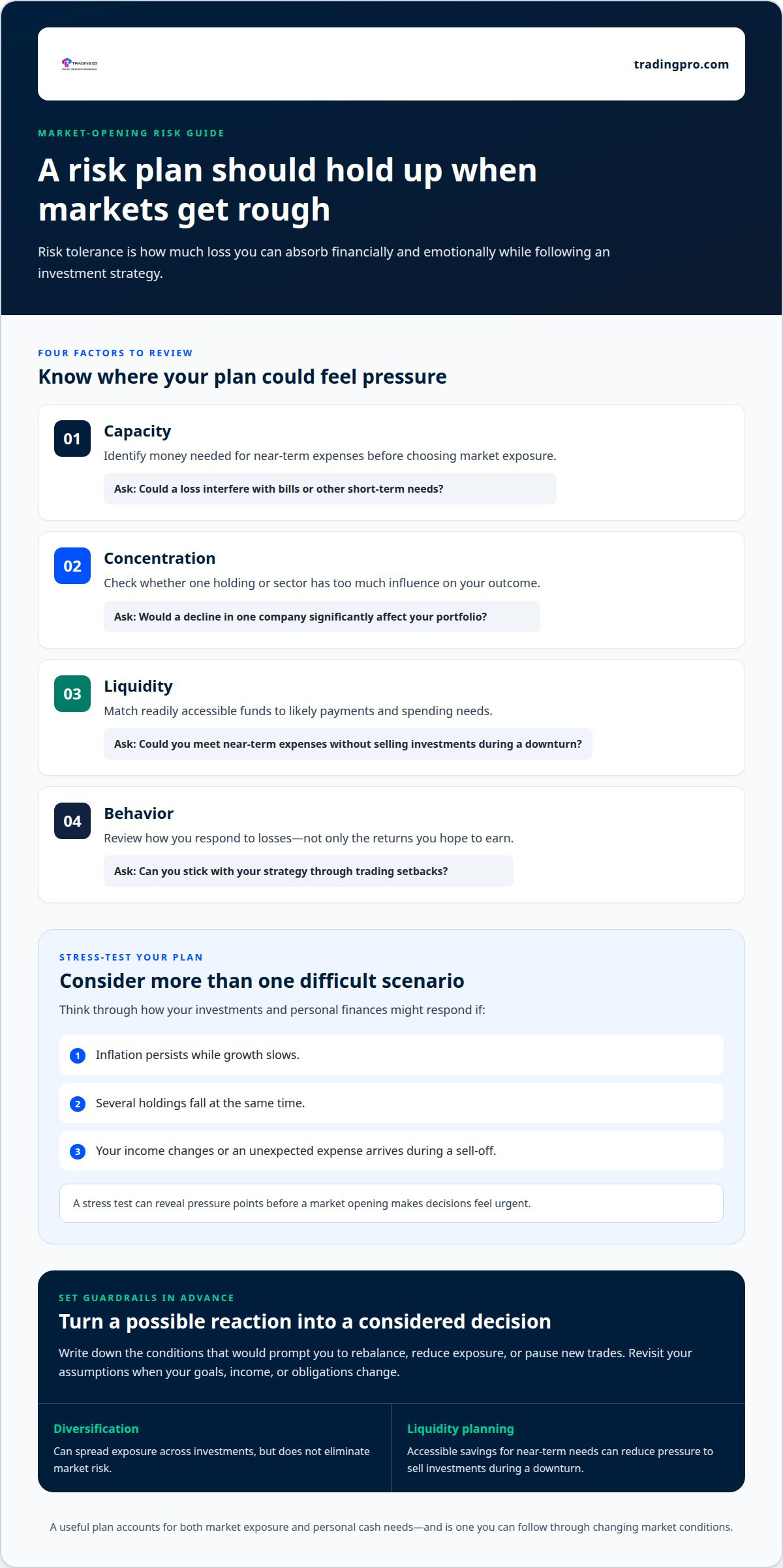
Risk tolerance is practical: how much loss can you absorb financially and emotionally while following an investment strategy? Consider your time horizon, near-term expenses, and how soon you may need the money you invest. If a sharp decline could force you to sell to cover bills, that money may not belong in a volatile position. A realistic plan accounts for both market exposure and personal cash needs.
Test your asset allocation against more than one difficult scenario. Consider persistent inflation alongside slowing growth, since both can affect asset values and spending plans. Ask how you’d respond if several holdings fell together, your income changed, or an unexpected expense arrived during a sell-off. A useful stress test identifies pressure points before a market opening makes every decision feel urgent.
Concentration matters. A portfolio with only a few holdings is more exposed to a decline in any one of them. Diversification spreads exposure across different investments, but it can’t eliminate market risk. If a single company makes up a large part of your portfolio, compare that exposure with a broader mix and decide whether the potential loss fits your plan.
Build liquidity into your review. Set aside enough readily accessible savings for near-term expenses and likely payments, rather than relying on selling investments during a downturn. This can reduce pressure to make last-minute decisions when prices are depressed. For an organization, map expected obligations against available cash and consider whether illiquid investments could make payments harder to meet.
Review how you respond to losses, not just the returns you hope to earn. Hypothetical results can’t capture every factor, including your ability to withstand losses or stick with a strategy during trading setbacks. Write down what conditions would prompt you to rebalance, reduce exposure, or pause new trades. Setting a rule in advance turns a reaction into a considered decision.
- Capacity: Identify money needed for near-term expenses before choosing market exposure.
- Concentration: Check whether one holding or sector has too much influence on your outcome.
- Liquidity: Match accessible funds to likely payments and spending needs.
- Behavior: Define how you’ll respond to losses before volatility tests your discipline.
A successful plan is one you can follow through changing market conditions, not simply one built around an attractive distribution of possible returns. Revisit your assumptions when your goals, income, or obligations change. Once your risk limits are clear, create an account to put your chosen trading approach into practice with defined boundaries.
3. Understanding causes of market volatility
Stock prices respond to company, industry, political, regulatory, market, and economic developments. A company earnings update can shift expectations for one stock, while an energy shock may affect businesses across several industries. In 2026, global markets experienced heightened volatility partly driven by geopolitical tensions and energy shocks stemming from the Iran conflict. Separate broad market movements from news affecting one holding before changing a portfolio.
Opening prices also reflect information that arrives while a market is closed. An overnight company announcement or geopolitical development, for example, can change buyers’ and sellers’ expectations before trading resumes. Orders then meet at prices that may differ from the previous close. The opening move shows how those orders interact; it doesn’t, by itself, reveal whether a company’s long-term outlook has changed.
Volatility can rise around the opening bell as overnight information and orders meet at the start of regular trading. This can lead to fast price movements, but the open isn’t always the most volatile period. News, available buyers and sellers, and changing expectations can influence activity throughout the session.
Market orders prioritize execution at available prices, so a fast-moving stock may fill at a different price than expected. A limit order sets a maximum purchase price or minimum sale price, but may remain unfilled if the market doesn’t reach it. If a stock opens above a buyer’s limit, for example, the order won’t execute at the higher price.
During the first 30 minutes, a sudden price gap can increase the risk of entering at an unfavorable level or reacting to a brief movement. A stop order can also trigger during a sharp move, while a stop-limit order may not execute if prices move beyond its limit. Decide in advance what price conditions fit your strategy, and avoid treating early volatility alone as a trading signal.
Trading volume can increase as pre-session orders meet new orders, while bid-ask spreads can change with liquidity and competing prices. A wider spread means a bigger gap between the best displayed buying and selling prices. A market order may cross that gap to execute, while a limit order can wait for a price within its boundary.
Interpret a movement by considering its cause, not just the chart. Check whether a company announcement, industry development, or broader economic news aligns with the price change. Then decide whether the event affects your investment case or only the timing of a trade. Rebalance according to your planned allocation and review schedule, not as an automatic response to every opening swing. This discipline helps you use context without assuming every fast move signals a lasting trend.
4. Using market volatility as an opportunity
Volatility can make prices more attractive, but a lower price alone doesn’t make an investment suitable. If you’re a beginner seeking to manage opening volatility without day trading, consider a steady investment plan, review your allocation on a schedule, and avoid decisions based only on the first price move. Navigating market opening volatility for beginners is about following a process, not predicting every short-term swing.
Dollar-cost averaging is one way to invest without trying to pick a single “perfect” entry point. You invest a fixed amount at regular intervals, buying more shares when prices are lower and fewer when they rise. Someone contributing the same amount on a recurring schedule, for example, follows a defined plan through market advances and downturns. This approach can reduce the pressure of timing the market, but it can’t prevent losses or guarantee a profit.
Keep your plan aligned with your time horizon. Someone investing for retirement decades away may have more time to withstand market declines than someone who expects to use the money soon. Target-date funds are designed for long-term investing across market cycles, but their design doesn’t remove investment risk. Consider whether a fund’s approach fits your goals and comfort with fluctuations.
Use volatility as a prompt to review your asset allocation, not as an automatic instruction to buy or sell. If market movements leave one part of your portfolio larger or smaller than intended, rebalancing can bring it closer to your planned mix. Set a review schedule or clear allocation thresholds in advance. A consistent rule reduces the chance that an emotional opening move drives a major portfolio change.
Trying to buy every dip can backfire. Prices may recover before a would-be buyer acts, leaving them out of the rebound. Selling after a downturn can also lock in losses and make recovery harder. Before trading, connect the decision to a goal: does it fit your time horizon, allocation, and need for cash? If fear of missing a move is the only reason, pause and return to your plan.
Keep short-term trading decisions separate from long-term investing. A retirement contribution plan, for example, can continue on schedule while you avoid impulsive trades around opening prices. Periodic investing still carries market risk, and diversification doesn’t assure a profit or protect against losses. Its practical value is discipline: each contribution follows your strategy rather than a prediction about tomorrow’s market.
As you build a routine for navigating market opening volatility for beginners, use this quick review before acting:
- Confirm the trade fits your stated goal and time horizon.
- Check whether it changes your planned allocation or cash needs.
- Decide whether you’d still take the action if prices weren’t moving sharply.
That pause turns market movement into information, not an order. A written plan helps you distinguish a genuine opportunity from a quick reaction.
5. What market volatility means
Volatility describes how widely an asset’s returns vary over time. It measures the size of price movements, not whether the next move will be up or down. Two stocks, for example, might have similar average returns but very different price swings. The stock with more variable returns has higher volatility, which can make its short-term value harder to predict.
Analysts commonly measure volatility using standard deviation or variance. Standard deviation describes how far returns tend to vary around their average. Variance also measures variation around the mean, but expresses it differently in the calculation. Neither measure tells you what a stock will do at the next market opening. Both help describe past movements over a selected period.
The time period matters. A volatility measure based on daily returns can tell a different story from one based on monthly returns. A short review window may reflect a recent burst of price movement, while a longer window includes more market conditions. Before comparing two assets, check that their volatility figures use comparable periods and return data.
Beta answers a related but different question: it measures an asset’s volatility relative to the overall market. Comparing beta can show whether an asset’s movements have historically been more or less pronounced than broad market movements. It doesn’t describe every risk the asset carries or predict its next price change.
For a beginner, turn the measure into a practical portfolio question: how would a wider range of returns affect your plan? If a stock’s price swings could make you sell at an uncomfortable moment, its exposure may exceed your tolerance. Stocks carry the risk of losing principal, and asset values can rise or fall. A volatility figure can inform your assessment, but it can’t remove that risk.
Use these steps to interpret a volatility measure:
- Identify the asset: Confirm whether the figure describes one stock, a portfolio, or a market index.
- Check the period: Compare measures built from similar return intervals and time windows.
- Read the metric: Use standard deviation or variance to assess return dispersion, and beta to compare movements with the broader market.
- Connect it to your plan: Consider how potential losses could affect your goals and decisions.
Volatility is a tool for describing uncertainty, not a trading signal on its own. Use it alongside your goals, time horizon, and asset mix. To put a considered trading plan into action, create your trading account.
To put a considered trading plan into practice, treat volatility as a description of how widely returns vary for a security or market index, not as a promise about future direction. Standard deviation describes how portfolio returns vary around their mean; beta describes volatility relative to the overall market. Keep those roles distinct when reviewing a measure. Investment values can fluctuate, so investors may gain or lose money. Volatility can help frame that uncertainty, but it can’t tell you which outcome will occur.
TradingPRO
TradingPRO offers Rookie, Micro, Pro, and Scalp Accounts for different trading styles. Once you’ve defined your risk limits and approach to volatile openings, choose the account type that fits how you plan to trade. Social Trading and Copy Trading can also let you replicate other traders’ strategies, but copying a strategy doesn’t remove market risk or guarantee a particular result.
Use this guide to make deliberate decisions, not to chase every opening move. If you’d like to discuss your trading approach, contact TradingPRO.
Make your next market decision deliberate
A beginner’s approach to navigating market opening volatility should start before the next session. Set a clear purpose for each trade, define the risk you can accept, and decide what information would change your view. That preparation gives you a framework to return to when prices move quickly, instead of letting urgency choose your next step.
Keep learning from your decisions. Record why you entered or avoided a trade, what you expected, and whether your reasoning still holds afterward. Over time, this practice can help you distinguish a repeatable process from a reaction to a single market move. Progress comes from building sound habits, not trying to predict every opening.
Ready to take a considered next step? Explore your options with TradingPRO and put your trading approach into motion with purpose.
Frequently Asked Questions
What causes price gaps between the previous close and market open?
Price gaps happen when new information changes the prices buyers and sellers are willing to accept while regular trading is closed. A company announcement released after the close, for example, may shift expectations before the next session. Orders placed before trading resumes then meet at prices that differ from the prior close. A gap shows a change in market pricing, but doesn’t reveal by itself whether the move will continue.
How can beginners practice handling opening volatility with paper trading?
Paper trading lets beginners rehearse decisions with simulated trades before risking money. Choose a stock, write down a trade idea and entry condition, then record what you’d do if the opening price moves past that level. Review whether your plan was clear and consistently followed. Simulated results aren’t actual investment results and can differ substantially from real performance. Practice can’t fully reproduce the pressure of potential losses.
What time does the U.S. stock market open, and which orders execute before then?
The U.S. stock market opens at its scheduled opening bell. Premarket orders can execute before then only if the broker accepts them for the premarket session and a compatible order matches.


