




- Published on: 2026-10-15 10:13:03
Segregated Client Funds: Why They Matter When Choosing a Broker in 2026

A segregated-funds disclosure can sound like a complete safety net. It isn’t. Segregation is a custody safeguard, not deposit insurance, a promise of full recovery, or protection from trading losses. Understanding segregated client funds importance starts with knowing what this safeguard is designed to do and where its limits begin.
It’s reasonable to want clear answers before placing money with a broker, especially if the firm encounters financial difficulty. This guide explains how client-money segregation differs from insurance-based investment funds and deposit protection, what may happen if a brokerage fails, and why rules about using client assets as collateral matter.
You’ll also get a practical checklist for reviewing a broker’s client-money disclosures, account terms, and contracting legal entity before opening an account. TradingPRO operates through regional entities, so identify the entity named in your account documents and review the terms that apply to it. Make a decision based on custody safeguards, not assumptions about trading outcomes.
Key Takeaways
- Learn what segregated client funds are designed to separate, and why segregation describes custody rather than trade performance.
- Understand the importance of segregated client funds without mistaking segregation for deposit protection or a safeguard against trading losses.
- Compare client-money segregation, deposit protection, and trading-risk controls by what each addresses and what it does not establish.
- Use a clear review sequence: identify the contracting legal entity, read its disclosures, understand stated limits, then decide.
- Compare account features only after reviewing the relevant terms for your entity, including TradingPRO’s Rookie, Micro, Pro, and Scalp account tiers.
What “segregated client funds” means for a brokerage account
In a brokerage account, segregated client funds are money or assets held for customers separately from the broker’s own operating funds. Operating funds pay the firm’s business expenses; client funds relate to customers’ accounts. The term describes how those assets are handled and kept, not whether a trade makes a profit or loss. A trade can lose value even when a firm separates client funds from its business funds.
That distinction sets the right expectations. Segregation is a custody and fund-handling arrangement, not deposit insurance, a guarantee of recovery, or a shield against market movements. What the arrangement requires and how funds are treated can depend on the account terms and applicable jurisdiction. A broad claim about “segregated funds” alone doesn’t explain which assets are covered or what process applies if a firm faces financial trouble.
The general idea of separating customer assets from a firm’s own property is also discussed under Security segregation or client funds. For a trader, the useful starting point is straightforward: identify whose assets are being separated, from which funds, and under what documented arrangement.
How broker client-money segregation differs from segregated investment funds
In the broker context, segregation refers to handling or custody of assets associated with a brokerage account, separate from the firm’s operating money. “Custody” means holding or administering assets on a customer’s behalf. By contrast, an insurance-based segregated investment fund is an investment product structured through an insurance contract. Its terms, risks, and any stated guarantees belong to that contract, not to a broker’s client-money arrangement. The wording may be similar, but the financial structures differ.
Why the distinction matters before opening a trading account
Marketing language can use “segregated” without spelling out the account-specific arrangement. Don’t assume that a phrase describing an insurance investment product explains how a broker handles client money, or that a general statement applies to every account and legal entity. The importance of segregated client funds lies in understanding the precise protection being described, rather than inferring more from a familiar label.
Before registering, look for the contracting entity named in the account documents and read the client-money or custody disclosures that apply to that entity. Check what the documents say is separated, how the arrangement is described, and what limits or exceptions are stated. This turns broad language into practical information: you can distinguish a documented fund-handling practice from a product feature, insurance coverage, or a claim about trading risk.
Keep the questions distinct as you review the terms. Where are client assets held? Which firm is responsible for the account? What do the disclosures say happens to those assets if the firm encounters financial difficulty? The answers help clarify the arrangement, but they don’t predict whether a trade will succeed or establish an automatic recovery outcome. Read the documents as a whole, with the exact wording and applicable entity central to your assessment.
How segregated client funds are intended to work, and where protection stops
Segregation is intended to keep money or assets held for clients distinct from funds a brokerage uses to run its business. Operational funds pay the firm’s expenses, while client money relates to customers’ accounts. This separation is meant to make those categories easier to identify and account for. It does not, by itself, tell you the exact account structure, who holds the assets, or how a legal process would treat them.
What segregation is designed to separate
A broker may describe processes for recording, holding, or administering client money separately from its own funds. Don’t assume that phrase means every client has an individually titled account or that a particular banking arrangement is in place. The relevant disclosures should explain the arrangement that applies. For a specific example of how a rule can address fund handling in a defined context, see the U.S. regulation on Segregation of leverage customer funds. Its scope is specific; it should not be treated as a universal rule for every brokerage account or jurisdiction.
In practical terms, clear records and separation can help show which funds relate to customers rather than the firm’s day-to-day operations. But segregation language alone doesn’t establish how assets are protected from every claim, what happens during insolvency, or how quickly funds could be returned. Those questions depend on the governing documents, the legal entity providing the account, and applicable local rules.
What segregated client funds do not automatically guarantee
Segregation concerns fund handling, not market performance: it does not prevent a trade from losing value, reverse a loss, or guarantee that a customer will recover a particular amount. Trading risk remains separate from custody arrangements. A position may fall in value regardless of how a broker holds or records client money.
Nor should segregation be read as automatic deposit insurance or guaranteed reimbursement if a firm fails. Those protections, where they apply, have their own eligibility rules, limits, and conditions. Don’t treat a statement about separate funds as proof that an insurance scheme covers your account or that recovery is assured.
Jurisdiction matters. Rules and account terms can differ depending on the contracting entity and the type of account or transaction. That’s why the importance of segregated client funds is practical: understand the specific arrangement and its limits before relying on the label. Identify the legal entity named in your registration documents, then compare it with the client-money disclosure and any stated exceptions. If the entity, terms, or applicable protections aren’t clear, pause and review the relevant documents before proceeding.
After reviewing the relevant account terms and disclosures, you can continue to account registration with a clearer understanding of what the documents say and what they don’t promise.
Segregated client funds vs other protections: compare the terms carefully
Protection terms can sound interchangeable, but each addresses a different risk. Client-money segregation concerns how funds are handled. Deposit protection concerns whether certain eligible deposits may be covered under a particular protection framework. Trading-risk controls address potential losses or account balances during trading. Don’t assume any of these applies to every client, account, or situation.
| Term | What it concerns | What it does not establish |
|---|---|---|
| Client-money segregation | Keeping client funds distinct from a firm’s operational funds, according to the arrangement described in applicable terms. | It doesn’t by itself prove that every balance is guaranteed, insured, or recoverable if a firm fails. |
| Deposit protection | Potential protection for eligible deposits under a specific jurisdiction’s scheme and rules. | It doesn’t establish that a brokerage account or its balances qualify. Eligibility depends on the applicable framework, account, and entity. |
| Trading-risk controls | Measures or account terms that address exposure to trading losses. Negative balance protection, where applicable, concerns whether losses can leave an account with a negative balance. | It doesn’t separate client money from firm funds or prevent a position from losing value. |
Segregation compared with deposit protection
Segregation is a fund-handling arrangement, not an insurance scheme. Deposit protection is a separate framework, and its scope isn’t universal. A broker’s use of the word “segregated” doesn’t show that a balance is an eligible deposit or that a protection scheme applies. Before relying on a protection claim, verify the contracting entity, account type, and terms of any relevant scheme using current, jurisdiction-specific information.
Keep the distinction clear: separate handling may describe how client money is managed, while deposit protection describes whether a scheme covers eligible funds under its rules. One doesn’t prove the other. Don’t infer that a brokerage balance has bank-deposit coverage just because a broker mentions a separate account or a regulated entity.
Segregation compared with negative balance protection
Negative balance protection concerns the account balance after trading losses, where such a safeguard applies and subject to its terms. Segregation concerns the handling of client funds. They address different risks, and neither removes the need to understand trading exposure. Review the account terms for stated limits, exclusions, or conditions rather than assuming the label applies in every scenario.
The practical test is to match each claim to its purpose and scope. Ask what risk the protection addresses, which legal entity provides it, and what the documents say it excludes. That’s the core of segregated client funds importance: separation can be relevant to custody, but it is not proof that every balance is guaranteed. Compare the disclosures carefully, then assess trading risk separately.
How to assess a broker’s client-fund disclosures before you register
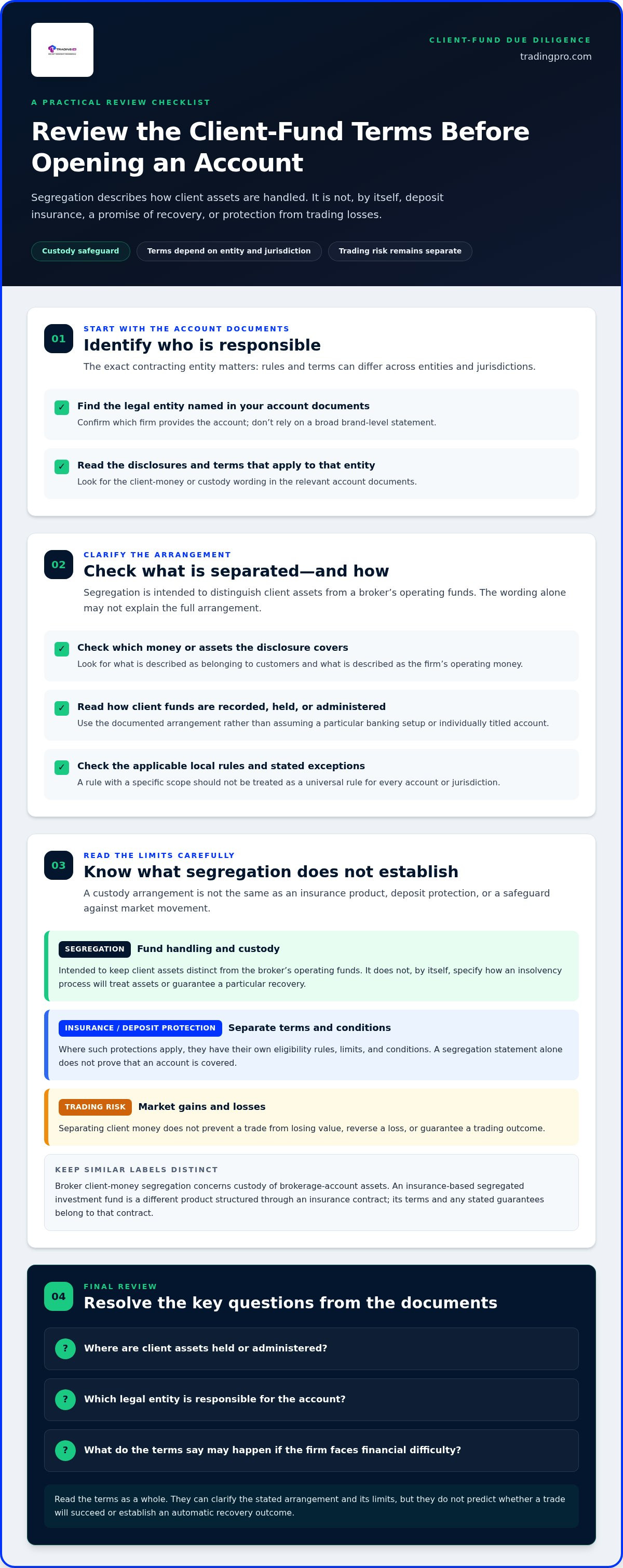
Turn a broad safety claim into a document check. Before opening an account, identify the legal entity you’ll contract with, find the disclosures that apply to it, understand their limits, and then decide whether the account fits your needs. This sequence helps you assess the terms that govern your relationship instead of relying on a headline or general statement about client funds.
Identify the entity and the documents that apply to your account
Start with the account terms, customer agreement, or registration documents. Look for the full legal name of the firm that will provide your account, along with the jurisdiction identified in the agreement. Then locate the client-money, custody, or risk disclosures connected to that same entity and account relationship. Don’t assume a document for one region or legal company describes the arrangements for another.
This check matters at TradingPRO, which operates through multiple regional entities, including Trading Pro Ltd in Mauritius and Trading Pro (PTY) LTD in South Africa. Match the entity named in your account documents to the relevant terms. A broker comparison can also help organize broader criteria; see what to look for in a broker for rookie traders alongside your review of the legal documents.
Turn disclosures into practical comparison questions
Read the wording closely. A useful review establishes what the disclosure actually describes, not what a general phrase seems to imply. Ask:
- How does the document define client money or client assets?
- What does it say about how those funds are held, recorded, or handled?
- Does it state limits, exceptions, or conditions that qualify the arrangement?
- Which jurisdiction and legal entity does the disclosure name?
- Does it distinguish fund handling from deposit protection and trading-related risks?
Look for precise descriptions rather than phrases such as “your funds are safe.” That kind of broad assurance doesn’t identify the funds covered, explain the arrangement, or establish a guaranteed outcome. If the disclosure is silent on a point, don’t fill the gap with assumptions. Record what the documents say and what they leave unanswered.
For first-account research, keep custody checks separate from learning how trading works. A forex trading guide for beginners can support your understanding of market participation, while the account documents explain the contractual relationship. These are different checks. The importance of segregated client funds lies in reading the actual terms before treating a safeguard as relevant to your account.
Once the entity and disclosures are clear to you, compare the account’s other features against your needs. Then proceed to TradingPRO account registration when you’re ready to make an informed choice.
Use fund-safety due diligence to make a more informed account decision
A sound account decision starts with the documents, not the feature comparison. First establish which legal entity your account agreement names and review the terms and disclosures that apply to that relationship. Then compare account features against your goals. This order keeps two different questions separate: how the account is structured and what trading features it offers. The importance of segregated client funds is in understanding what the documents actually say before relying on a protection claim.
Apply the checklist to a TradingPRO account choice
TradingPRO offers Rookie, Micro, Pro, and Scalp account tiers. These are account options, not evidence of a particular client-money arrangement. Assess the account terms for the entity named in your registration documents independently of the tier you’re considering. If you’re comparing entry-level account formats, review the Rookie Account details as part of your account-feature research, then return to the applicable legal and client-money disclosures for custody questions.
Keep your comparison organized. A simple note for each account can capture the feature you’re evaluating, the document that describes it, and any limits or conditions stated there. That makes it easier to distinguish a documented account feature from a broad claim and to spot when a term applies to a different entity or account relationship. Don’t treat a tier name or marketing description as a substitute for the agreement.
Take the next step with clear expectations
Before completing registration, pause for a final document check. Confirm the contracting entity shown in the account terms, make sure you’re reading disclosures that correspond to it, and note any limits or exceptions that affect your understanding. If key wording remains unclear, resolve that uncertainty through the relevant account documentation before proceeding. A deliberate review gives you a stronger basis for deciding, without implying that any safeguard guarantees recovery, protects against losses, or determines trading results.
- Entity: Does the account agreement name the firm you expect to contract with?
- Disclosure: Do the client-money terms correspond to that entity and account?
- Limits: Have you identified the qualifications, exceptions, and conditions stated?
- Choice: Have you compared account features separately from fund-handling claims?
Once you’ve reviewed the applicable account terms and are ready to proceed, Register for a TradingPRO account. Make your choice with clear expectations and a firm grasp of the documents that govern your account.
Make your next account decision with clarity
Let the documents set your baseline before account features shape your shortlist. The importance of segregated client funds isn’t about expecting a risk-free experience. It’s about making a deliberate choice with a clear view of the terms that apply to your account and the limits of any stated safeguards.
TradingPRO offers Rookie, Micro, Pro, and Scalp account tiers and operates through multiple regional entities. Match your registration documents to the relevant entity-specific disclosures before deciding which account suits your approach. Keep that review separate from your assessment of trading goals, risk tolerance, and account features.
When you’re comfortable with the applicable terms and ready to take the next step, register for a TradingPRO account. Make your choice with clear expectations, grounded in what the documents actually say.
Frequently Asked Questions
What are segregated client funds?
Segregated client funds are customer assets kept separate from a brokerage firm’s own operating funds under an arrangement described in its terms. For example, a broker may hold cash connected to customer accounts apart from money used for its business expenses. The label doesn’t necessarily mean each client has a separate account. Check the broker’s documents to see which assets are covered and how the arrangement is described.
Why are segregated client funds important?
The importance of segregated client funds lies in distinguishing assets held for customers from money used to run the firm. That distinction can support clearer accounting and help identify client assets if the firm faces financial difficulty. It isn’t a guarantee of return or reimbursement. As a practical step, compare the disclosure’s description of the arrangement with the legal entity and account named in your agreement.
Are segregated client funds protected if a broker becomes insolvent?
Segregation may be intended to help distinguish client assets from the broker’s own funds, but it doesn’t guarantee that assets will be returned in full or promptly if the firm becomes insolvent. The outcome can depend on the account terms, applicable law, records, and circumstances such as a shortfall. Before relying on the safeguard, identify the entity in your agreement and review its insolvency and client-money disclosures.
Do segregated client funds protect me from trading losses?
No. Segregation concerns how client assets are handled, not the performance of a trade. If a position loses value, separating client funds from a firm’s operating money won’t reverse that loss. For example, a price move against an open position can reduce account equity regardless of the broker’s fund-handling arrangement. Review trading-risk terms separately, including any stated controls or limits that apply to your account.
Are segregated client funds the same as deposit insurance?
No. Segregation describes a fund-handling arrangement; deposit insurance is protection under a specific scheme with its own rules. A brokerage balance isn’t automatically an eligible insured deposit just because a broker describes funds as separate. Eligibility depends on the relevant scheme, account, and legal entity. Check current information from the applicable scheme and compare it with your broker’s account documents before assuming coverage applies.
Are segregated client funds the same as segregated investment funds?
No. In brokerage disclosures, segregation generally refers to how client money or assets are handled. A segregated investment fund can instead refer to an investment product structured through an insurance contract, with features set out in that contract. The shared term can cause confusion, but one arrangement doesn’t establish the terms or safeguards of the other. Check whether the document describes a brokerage account or an insurance-based investment product.
How can I check whether a broker’s client-fund disclosures apply to me?
Compare the legal entity named in your account agreement or registration documents with the entity named in the client-fund disclosure. Then check that the disclosure covers your account relationship and note any stated exceptions, limits, or jurisdiction-specific conditions. If the names differ, don’t assume the document applies to you. Use the relevant entity’s current account terms and disclosures as your reference before deciding to register or fund an account.


