




- Published on: 2026-08-28 10:41:40
A-Book vs B-Book Broker Models: The 2026 Guide to Execution Transparency
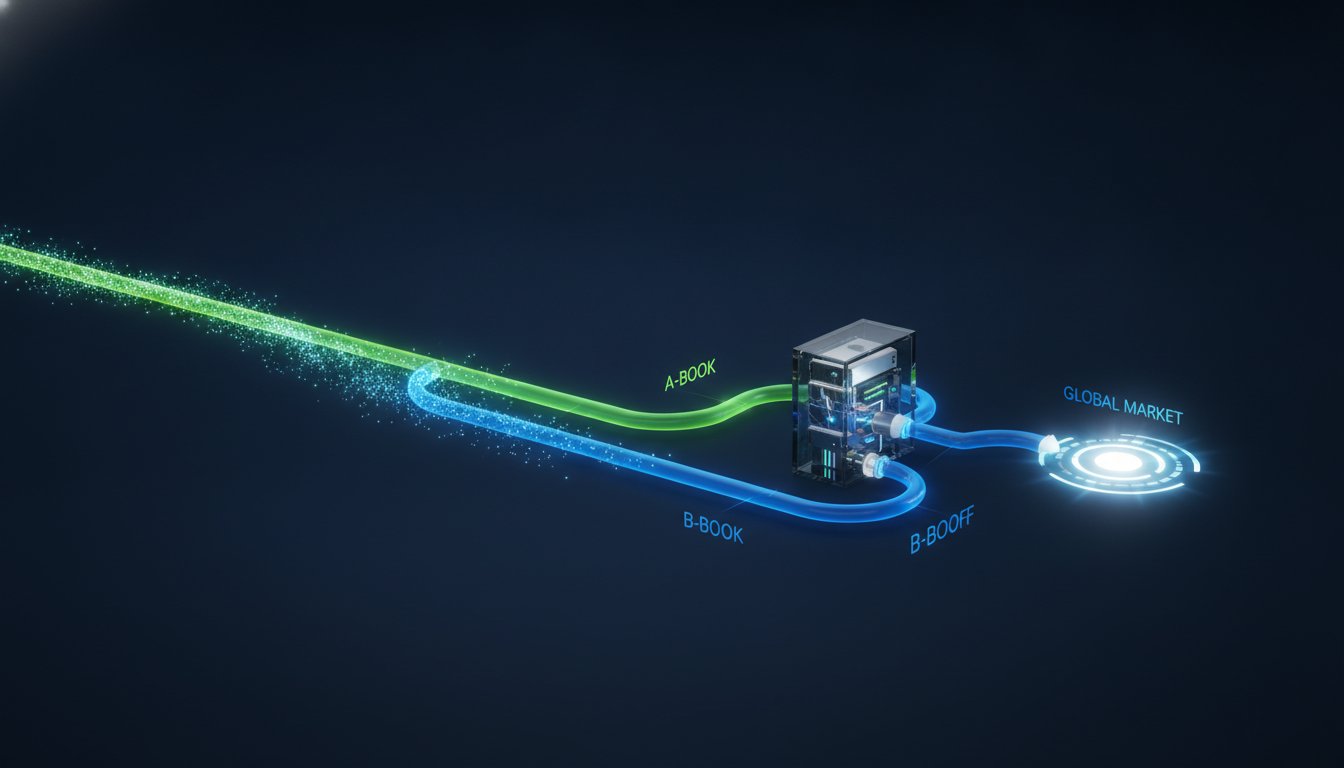
The "zero commission" account you just opened might be the most expensive mistake of your trading career. While "free" trading sounds elite, the hidden cost of execution transparency often determines whether you achieve market dominance or get left behind. Understanding the A-book vs B-book broker model is no longer optional for those seeking peak performance. It's the definitive line between a frictionless path to profit and a rigged game.
You've likely felt the frustration of high slippage during news events or wondered why a stop-loss was hit when the price action seemed stable. We agree that your broker should be a facilitator, not a competitor. This guide empowers you to master the mechanics of broker infrastructure so you can eliminate conflicts of interest and maximize your edge. We'll break down the technical shift from STP to Market Making and help you identify the precise model your strategy requires. Whether you're hunting for the high-octane speed of a Scalp account or building institutional stability, we provide the blueprint for total execution transparency.
Key Takeaways
- Decode the mechanical difference between external routing and internal risk management to protect your capital from hidden conflicts.
- Master the A-book vs B-book broker model to select the specific infrastructure that eliminates latency and maximizes your execution edge.
- Align your trading strategy with the right environment, utilizing the Scalp Account for high-frequency precision or the Rookie Account for entry-level liquidity.
- Secure your Social Trading success by ensuring your execution model supports accurate replication and deep liquidity for every follower.
- Identify the elite infrastructure required to eliminate requotes and minimize slippage during high-volatility market events.
What are A-Book and B-Book Broker Models?
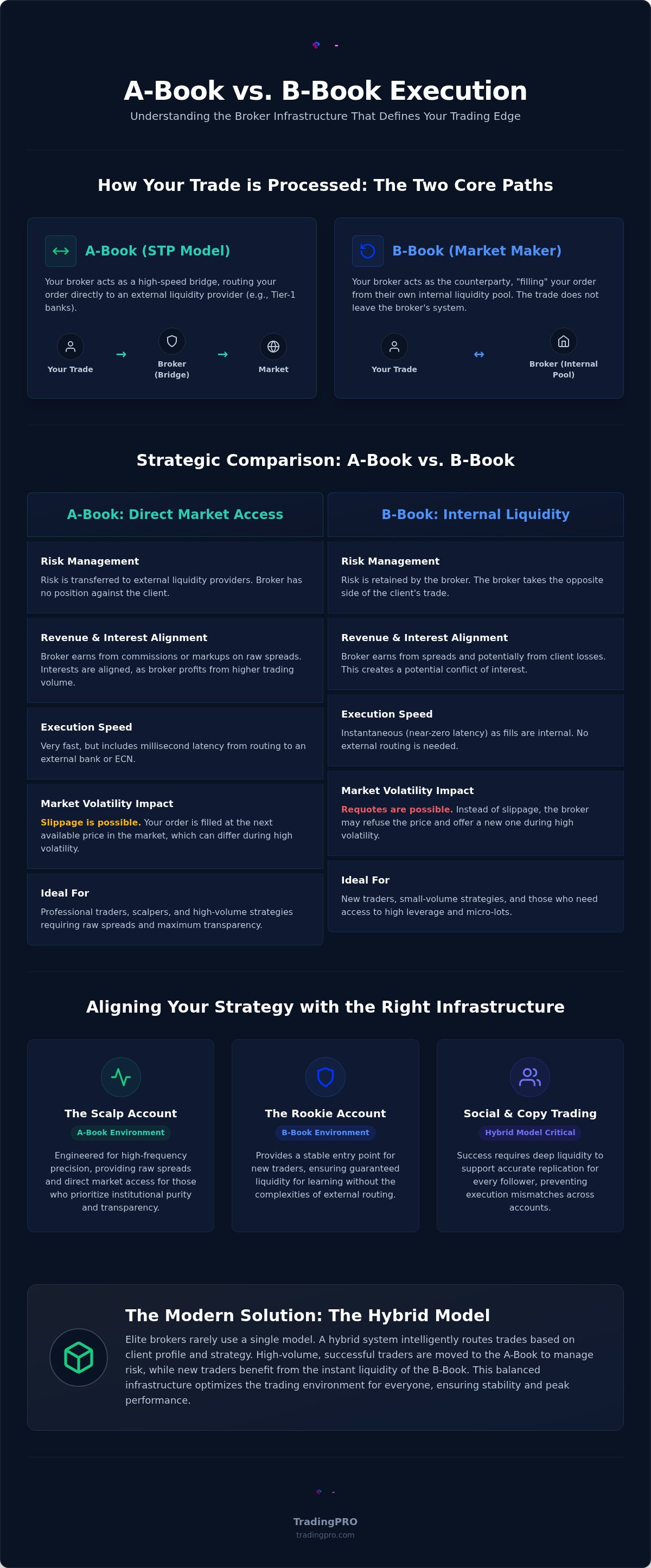
Your broker's execution model isn't just technical jargon; it's the DNA of your profitability. At its core, the A-book vs B-book broker model debate centers on where your trade goes once you click "buy" or "sell." The path your order takes determines your execution speed, the likelihood of slippage, and whether your broker profits with you or from you. Elite traders don't leave this to chance. They demand institutional-grade transparency.
The fundamental differences between these models include:
- Risk Placement: In an A-book model, the risk is transferred to external markets. In a B-book model, the broker retains the risk.
- Revenue Streams: A-book brokers earn through commissions or markups. B-book brokers earn from the spread and the net result of their internal liquidity pool.
- Execution Environment: A-book relies on external depth, while B-book provides an immediate, internal match for your order.
Modern industry leaders rarely stick to a single path. Most elite platforms utilize a Hybrid model. This allows them to route high-volume professional orders to the open market while providing the instant liquidity needed for smaller accounts. It’s about optimizing the environment for the specific strategy being deployed.
The Mechanics of A-Book Execution (STP)
Straight-Through Processing (STP) is the gold standard for transparency. When you execute a trade in an A-book environment, your broker acts as a high-speed bridge. They instantly route your order to an external pool of Tier-1 banks and prime brokers. This eliminates the direct conflict of interest because the broker wants you to succeed and continue trading. Platforms like the Scalp Account are engineered for this exact purpose, providing raw spreads and direct market access for those who prioritize institutional purity.
The Mechanics of B-Book Internalization
B-book brokers operate as Market Makers. Instead of sending your trade to a bank, they "fill" the order themselves. This internalization allows for incredible speed and guaranteed fills, even when the broader market is thin or volatile. It's the engine that powers accessibility. Because the broker manages the risk internally, they can offer features like high leverage and micro-lot sizes that wouldn't be feasible in a pure A-book environment. The Rookie Account often utilizes this model to provide a stable entry point for new traders, ensuring they have the liquidity needed to learn the ropes without the complexity of external routing.
A-Book vs B-Book: A Strategic Comparison for 2026
Execution quality is the silent engine of your trading success. In the high-stakes environment of 2026, the A-book vs B-book broker model choice dictates whether you experience institutional-grade precision or retail-level frustration. Speed is the first differentiator. Internalized B-book environments often boast near-zero latency because there is no external "hop" to a liquidity provider. However, this speed comes with a trade-off. While A-book bridged execution might introduce millisecond delays, it connects you to the raw depth of global markets.
Slippage and requotes represent the two sides of the execution coin. In a pure A-book environment, slippage is a market reality; if the price moves before your order hits the bank, you get the next best price. B-book brokers often eliminate slippage but may introduce requotes, where the dealer refuses your price during volatile swings. For those seeking total control, tools like the Trade Hub allow you to monitor these metrics in real-time. Choosing between raw spreads with commissions or markups with "zero fees" depends entirely on your strategy's sensitivity to cost versus speed.
Revenue Models and Conflict of Interest
A conflict of interest in B-book market making exists when the broker’s financial gain is mathematically tied to the trader's net losses. A-book brokers, conversely, align their success with your longevity. They want you to trade high volumes over many years because their revenue comes from commissions. Elite brokers now utilize a hybrid solution. They move successful, high-volume traders to A-book routing to manage institutional risk while keeping the environment stable for everyone. If you're ready to experience this balanced infrastructure, open your professional account today.
Regulatory Evolution in 2026
The 2026 regulatory landscape has forced a massive shift toward verifiable execution. A global crackdown on Payment for Order Flow (PFOF) means brokers must prove they are delivering the best possible outcome for the client, regardless of the model. Negative Balance Protection is now an industry standard, ensuring you never lose more than your initial deposit. This provides a safe-haven for ambitious traders to pursue significant goals without the fear of catastrophic debt. Stay ahead of these shifting requirements by following the latest updates on the TradingPRO Blog.
Matching the Model to Your Trading Style
Elite trading requires more than a sharp eye for charts; it demands a surgical alignment between your tactics and your broker's engine. The A-book vs B-book broker model choice isn't a moral one. It's a logistical one. If you're firing off dozens of trades a minute, you need institutional purity. If you're testing the waters with a small deposit, you need the flexibility of internalized liquidity. Success comes from knowing which environment fuels your specific edge and when to transition as your capital grows.
Your decision should be based on three critical pillars:
- Execution Sensitivity: Does your strategy depend on millisecond precision or can it tolerate minor price shifts?
- Capital Efficiency: Do you require high leverage and micro-lot accessibility to manage risk?
- Holding Duration: Are you in and out in seconds, or are you focused on long-term structural moves?
Identifying your needs early prevents the frustration of using a high-performance strategy on an incompatible infrastructure. It's about choosing the right tool for the job.
Why Scalpers Require A-Book Purity
High-frequency scalpers operate in a world where a single pip determines the day's result. In this environment, B-book "Last Look" execution is a liability. Market makers might take a few extra milliseconds to decide whether to accept your trade, often resulting in requotes during peak volatility. Pure A-book routing ensures your order hits the global liquidity pool instantly without interference. This is why professional-grade setups prioritize ECN-style connectivity to avoid "dealer intervention" during fast moves. For a deeper dive into the technical requirements of high-speed trading, explore our Best Trading Infrastructure for Scalping guide.
The "Rookie" Advantage of Internalized Liquidity
While A-book is the target for high-volume pros, the B-book model provides the essential scaffolding for newcomers. Internalized liquidity allows for $1 minimum deposits and fractional lot sizes that Tier-1 banks simply don't touch. This model prevents "failed execution" for small retail orders that lack the volume to move through institutional bridges. It's the most efficient way to build a track record without exposing significant capital to the raw volatility of the interbank market. The TradingPRO Rookie Account leverages this internalization to offer a frictionless entry point for emerging talent.
Swing traders have different priorities. Because they hold positions for days or weeks, the millisecond execution speed of the A-book vs B-book broker model matters less than swap rates and overnight carry costs. When your horizon is wide, focus on brokers that offer competitive financing and institutional stability. Balance your need for leverage against the cost of maintaining your positions to ensure your edge isn't eroded by carry fees.
The Hidden Impact on Social and Copy Trading
Social trading success depends on more than just picking a profitable Master. It requires an infrastructure that can replicate trades with institutional precision. The A-book vs B-book broker model is the invisible force that determines if your account actually captures the Master’s edge. If the execution models between the Master and the Follower don't align, the resulting price distortion can erase your profit margins before the trade even matures. Elite copy trading demands a frictionless bridge between accounts.
Execution transparency in the social ecosystem hinges on three factors:
- Replication Accuracy: External A-book routing ensures everyone in the pool receives the same institutional price feed simultaneously.
- Liquidity Depth: Internalized B-book environments may struggle to fill 1,000+ followers at the exact same price point during high-volatility events, leading to inconsistent results.
- Execution Verification: Transparency in the social feed allows you to see if a Master is using a professional-grade environment or a restricted retail setup.
Avoiding "Slippage Leakage" in Mirror Trading
Slippage leakage occurs when millisecond delays in the execution bridge cause the Follower’s entry price to differ from the Master’s. Even a one-pip difference can turn a winning strategy into a losing one over time. This is why understanding Social Trading vs Copy Trading is essential for anyone looking to build long-term wealth through mirror trading. Our infrastructure is engineered to minimize this latency, ensuring that every Follower account receives the same high-octane execution as the strategy provider. We eliminate the lag that traditionally plagues retail copy platforms.
Evaluating Master Traders by Account Tier
Don't just look at the percentage gain. Check the infrastructure. A Master Trader operating on a ScalpX account is utilizing A-book routing designed for high-frequency precision. This provides a cleaner signal for you to follow. Use the Trade Hub to verify execution stats and ensure you're joining a network built on transparency rather than hidden markups. Choosing a network that prioritizes institutional-grade routing is the only way to ensure your capital is treated with the same respect as a professional's. High-performance social trading requires a partner that doesn't compromise on speed. Register your account now to access a social ecosystem built for dominant market players.
TradingPRO: Institutional Infrastructure for Every Tier
Execution shouldn't be a mystery; it should be a competitive advantage. TradingPRO provides the precision-engineered infrastructure required to dominate the markets, ensuring your strategy is never throttled by outdated technology. Understanding the A-book vs B-book broker model is the first step toward professional maturity, and our platform is built to support that evolution. We've eliminated the "one-size-fits-all" approach that slows down elite traders. Instead, we offer a multi-tiered ecosystem where execution quality is the priority, regardless of your capital size or strategy complexity.
Our infrastructure operates with the gravitas of a global leader. We provide the stability of institutional-grade routing for high-volume pros while maintaining the accessibility required for newcomers. This includes a robust social trading ecosystem where followers can replicate master strategies with the same high-speed execution that defines our core brand. It's a frictionless experience that protects your edge and ensures that as you scale, your execution environment scales with you.
Choosing Your Ideal Trading Environment
Selecting the right account is a decisive move for your trading career. We've structured our tiers to match the specific mechanics discussed throughout this guide. Whether you're seeking the raw power of the interbank market or a stable entry point, we have a solution:
- Rookie and Micro Accounts: Optimized for entry-level liquidity and fractional lot sizes through efficient internalization.
- Pro Account: A balanced environment for experienced traders seeking a mix of speed and competitive costs.
- Scalp Account: Our flagship NDD (No Dealing Desk) environment, engineered for raw spreads and direct institutional routing.
Our infrastructure acts as your expert guide, providing the tools and confidence needed to excel in a fast-moving landscape. We provide the environment to suit your global ambitions without compromise. Register your account today to experience elite execution.
Tools for the Modern Professional
Transparency is the bedrock of our partnership. We don't just claim execution quality; we prove it. The Trade Hub empowers you with real-time execution data, allowing you to monitor your trade journey with institutional clarity. This level of insight is essential for verifying that your strategy is receiving the best possible market fill, eliminating the guesswork that plagues other platforms.
To accelerate your growth, you can leverage our Deposit Bonus to scale your strategy across different models. This additional capital allows you to test the waters of different account tiers while maintaining your risk management protocols. TradingPRO remains the safe-haven for ambitious traders who refuse to settle for mediocre execution. We are committed to maintaining a cutting-edge image by delivering the results-driven environment you deserve.
Secure Your Trading Edge with Institutional Transparency
Mastering the A-book vs B-book broker model is the final step in transitioning from a retail participant to a market dominant force. You now understand that execution isn't just about speed. It's about the integrity of the bridge between your capital and the global liquidity pool. Whether you're leveraging the internalized liquidity of a Rookie Account or the raw, high-frequency power of a Scalp Account, your infrastructure must match your ambition. Success in 2026 demands a partner that prioritizes your longevity over their own internal markups.
TradingPRO delivers this precision through a multi-tiered infrastructure designed for every stage of your career. Our institutional-grade Scalp accounts and advanced Social Trading ecosystem ensure your strategy replicates with absolute accuracy. We provide the decisiveness and security you need to excel in a fast-moving landscape. Don't let hidden costs or execution lag dictate your results. Take control of your financial journey with a global leader committed to total transparency and your ultimate success. The markets are moving; it's time you moved with them.
Master the Markets with TradingPRO: Register Now
Frequently Asked Questions
Is a B-book broker a scam?
Internalization is a standard industry practice; it's not a scam. Regulated brokers use the B-book model to provide instant liquidity and accessibility for retail traders. It only becomes a problem if a broker lacks transparency or manipulates price feeds. This model allows for features like micro-lots and high leverage that the interbank market doesn't support. It's a legitimate tool for market accessibility when handled by a dominant, reputable authority.
How can I tell if my broker is A-book or B-book?
Identify your broker's model by examining their execution policy and account specifications. Accounts featuring "Raw Spreads" plus a commission usually indicate A-book routing. Conversely, "Zero Commission" accounts with wider markups typically rely on B-book internalization. Look for No Dealing Desk (NDD) certifications in the legal documentation. Using real-time monitoring tools like the Trade Hub provides the definitive proof of execution transparency you need to trade with absolute confidence.
Which model is better for scalping strategies?
High-frequency scalping requires the institutional purity of A-book routing. Scalpers depend on millisecond precision and raw market depth to capture small price movements. The A-book vs B-book broker model choice is vital here because B-book "last look" protocols can lead to requotes during peak volatility. Elite traders choose ECN-style accounts to ensure their orders hit the global liquidity pool instantly without any dealer intervention or artificial delays.
Do A-book brokers have higher spreads?
A-book brokers typically offer tighter, raw spreads because they pass prices directly from Tier-1 liquidity providers to you. They earn revenue through a transparent commission rather than marking up the price. B-book brokers often provide wider spreads because their profit is baked into the bid-ask difference. A-book trading has a clear per-trade cost, but it often results in lower total transaction costs for high-volume professionals seeking institutional-grade pricing.
What is a Hybrid broker model?
The Hybrid model is a sophisticated risk management strategy used by global leaders to optimize execution. The broker routes high-volume professional trades to external markets via A-book while internalizing smaller retail orders through B-book liquidity. This creates a balanced ecosystem that supports both high-octane performance and retail accessibility. It allows for specialized environments, such as the Scalp Account for pros and the Rookie Account for beginners, to coexist seamlessly.
Why do B-book brokers offer higher leverage?
B-book brokers offer higher leverage because they control the entire internal trade environment. Since these trades don't hit the external interbank market, the broker isn't forced to meet the strict margin requirements of Tier-1 banks. This flexibility empowers traders with smaller deposits to pursue significant goals with maximum market exposure. It's a strategic advantage for those looking to build momentum and scale their capital in a controlled, high-performance setting.
Does the execution model affect my copy trading results?
Your execution model is the silent driver of your copy trading success. If the Master and Follower accounts operate on different models, "slippage leakage" can occur, causing the follower to get a worse price. A-book execution ensures that every follower in the pool receives the same institutional price feed simultaneously. B-book brokers might struggle to execute thousands of mirrored trades at once without distortion. Always prioritize platforms with high-speed replication infrastructure.
Is A-book execution safer for large deposits?
A-book execution is the gold standard for managing large deposits and institutional-sized capital. It removes any potential conflict of interest because the broker doesn't profit from your losses. Your risk is transferred to global liquidity providers, creating a "safe-haven" feel for your significant assets. Both styles are safe under regulation, but the transparency of the A-book vs B-book broker model provides the security and peace of mind that elite professionals demand.


